
Celebrating the Broadside
A Collections Chronicles Blog
by Martina Caruso, Director of Collections and Exhibitions
July 23, 2026
In my role, I spend much of my time working with objects that were never meant to survive. Some were used every day, others were treasured keepsakes, and many were simply discarded once they had served their purpose. Few formats embody that idea better than the broadside.
This raises a question that we hear frequently in the 21st century: What is a broadside? A broadside is a single sheet of paper that features printing on one side. These were historically used to share news, advertise events, announce public meetings, or persuade the reader to support a cause. In many ways, it was the poster of its day—and perhaps we could even go so far as to say it was the social media post of the 18th and 19th centuries. Designed to grab attention quickly, broadsides were meant to be read, discussed, and then thrown away.
Because they had such a short life, relatively few survive today. Yet those that do offer an extraordinary window into everyday life. They preserve the voices, concerns, advertisements, political debates, and ambitions of the people who created and read them.
One of my favorite things about broadsides is how intentionally they were designed. Printers knew exactly how to capture someone’s attention. They emphasized the most important message with bold decorative type, while setting supporting information in smaller text. You can read a broadside in two ways: by scanning the large headlines for the quick takeaway, or by slowing down and reading the entire story. In that sense, not much has changed over the last 200 years.
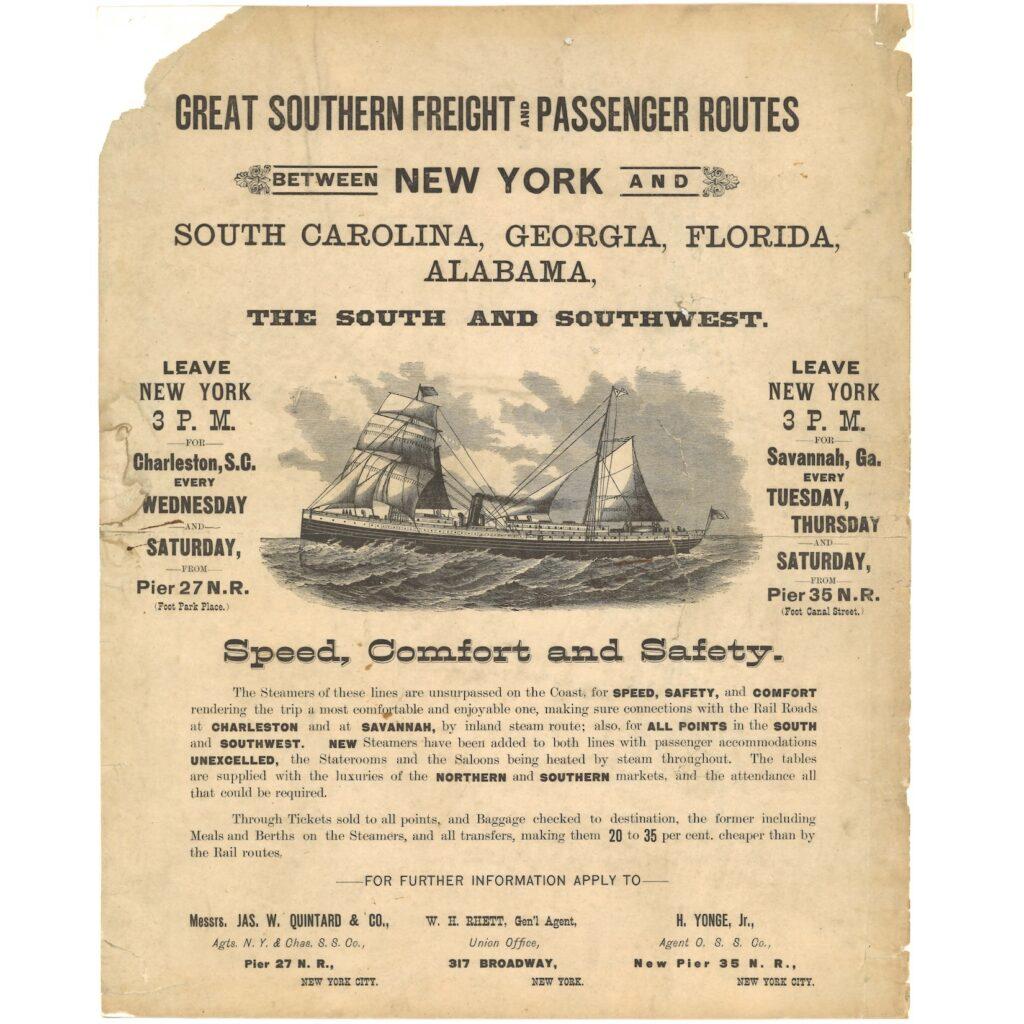

Left: [Broadside for steamship lines between New York and South Carolina, Georgia, Florida, and Alabama] ca. 1970-1885. Seamen’s Bank For Savings Collection 1991.077.0049
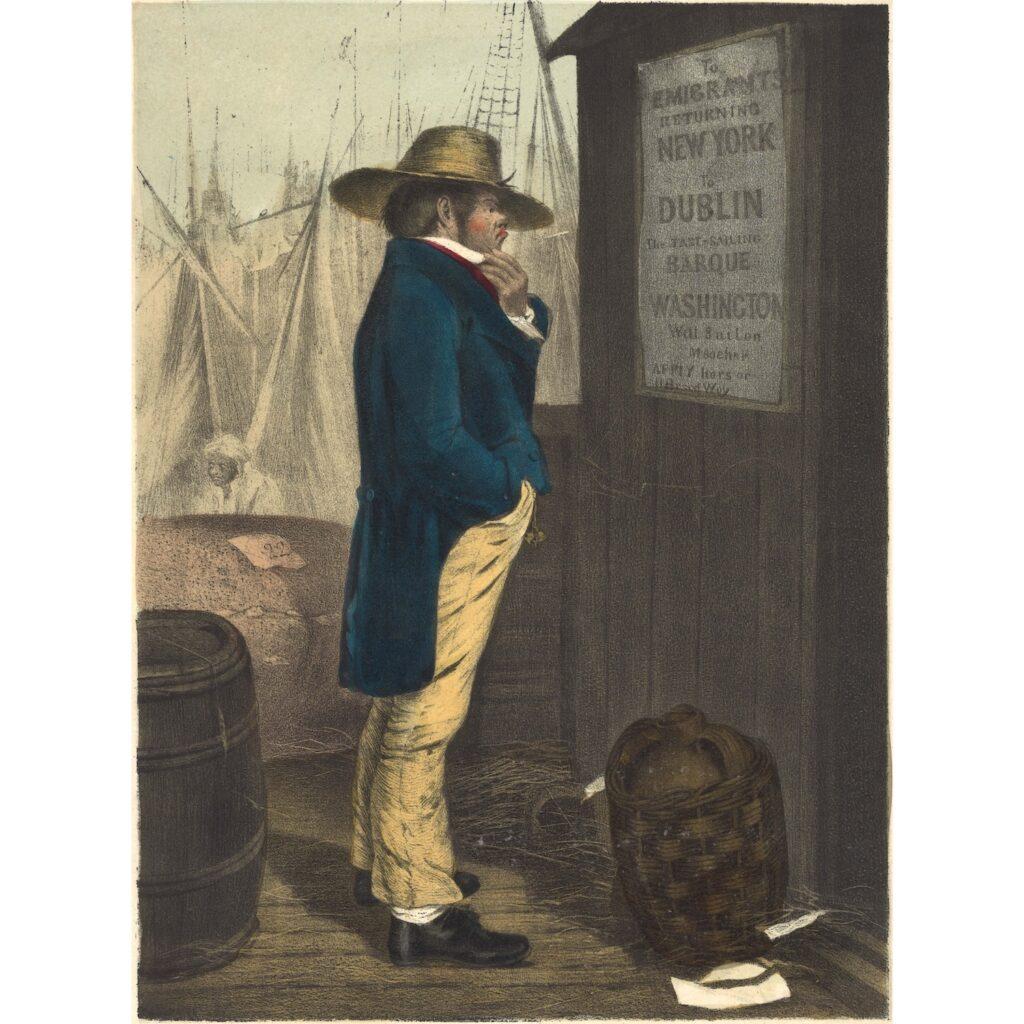
Center: “Homeward Bound (New York)” ca. 1854. F. Sala & Co., printer. Gift of Fritz Gold 1994.017.0003
Right: [Broadside advertising steamer C.H. Northam and the First-Class Steamer Continental] ca. 1875. Penrose, Lowe & Co., printers. Gift of Peter Stanley 1977.014
Broadsides were usually produced quickly and inexpensively, often in large quantities. They were posted in public squares, taverns, churches, and marketplaces, handed out by street vendors, or sold for only a few cents. Their purpose was immediate impact—not permanence.
Over the centuries, broadsides announced everything from ship departures and theatrical performances to political campaigns, public proclamations, auctions, and social reform movements. They documented moments that mattered to ordinary people, often long before newspapers or books could tell the story.
At the South Street Seaport Museum, we care deeply about these seemingly ordinary pieces of paper. Our collection includes hundreds of broadsides and other printed ephemera documenting New York City’s vibrant commercial life—from ocean voyages and Hudson River steamboat excursions to auctions, theatrical performances, political campaigns, and public notices.
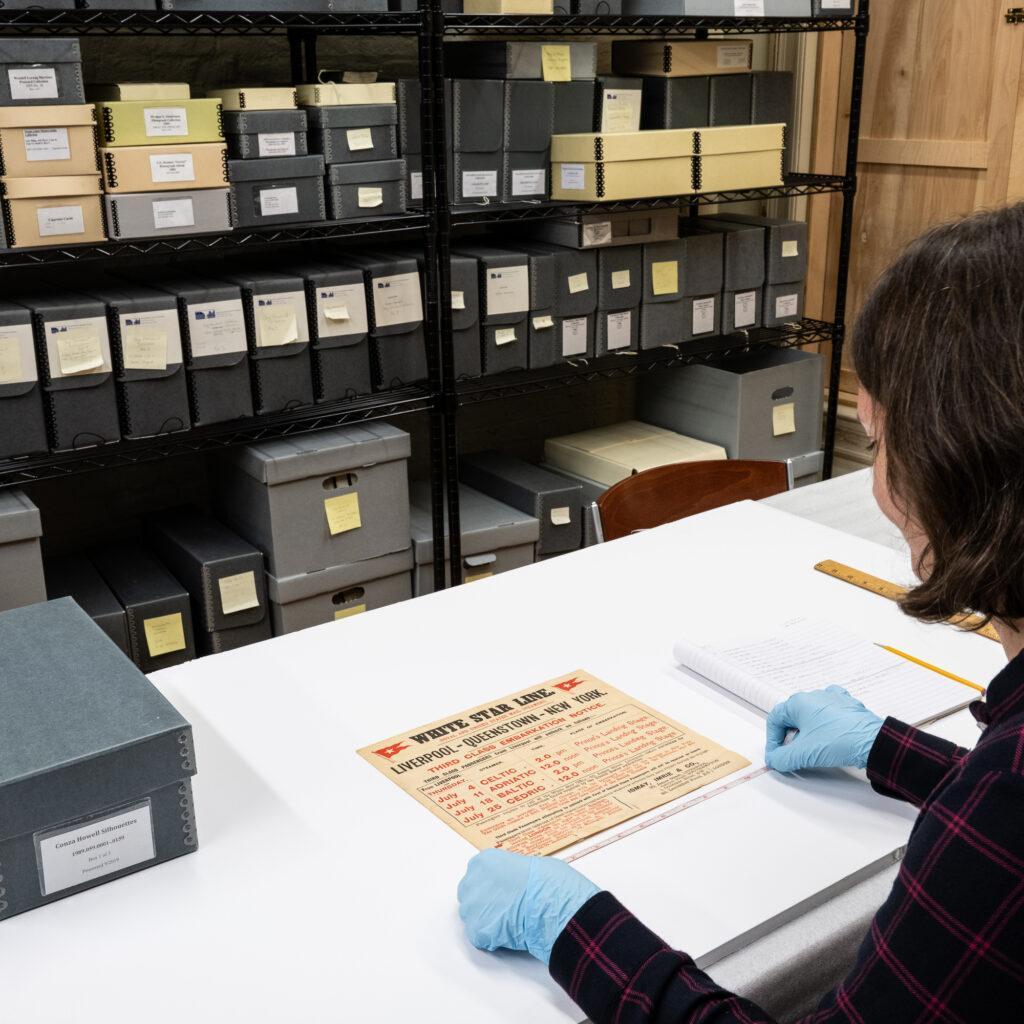
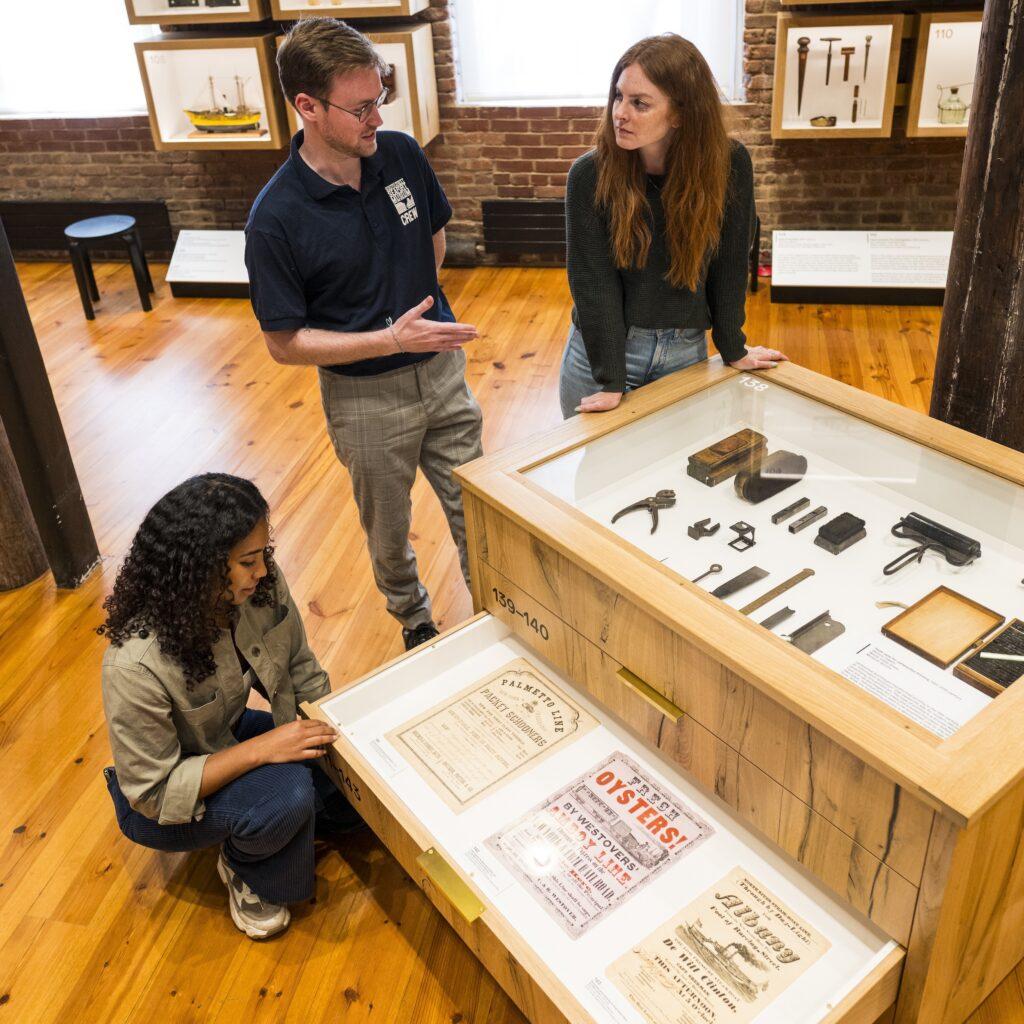
Photo credit Richard Bowditch
There is hardly an aspect of 19th century city life that isn’t reflected somewhere in these remarkable sheets. You can browse a selection from the Museum’s collections and archives for free on our Collections Online Portal or come visit our Maritime City exhibition galleries to see some examples on display.
For this blog, however, I’d like to focus on two subjects that perfectly connect the Museum’s collections and current exhibitions: transportation by water, and the central role New York City played in the establishment of the United States.
Through a handful of remarkable broadsides, we’ll explore how printers shared news, promoted ocean travel, celebrated technological innovation, and helped shape the movement of people and ideas across the oceans.
Ocean Traveling
Transatlantic broadsides were large, illustrated posters printed by 19th century sailing and steamship companies. They aggressively marketed Gold Rush voyages from the East Coast to California, and passage to European immigrants and travelers—promising fast, scheduled travel across the oceans.
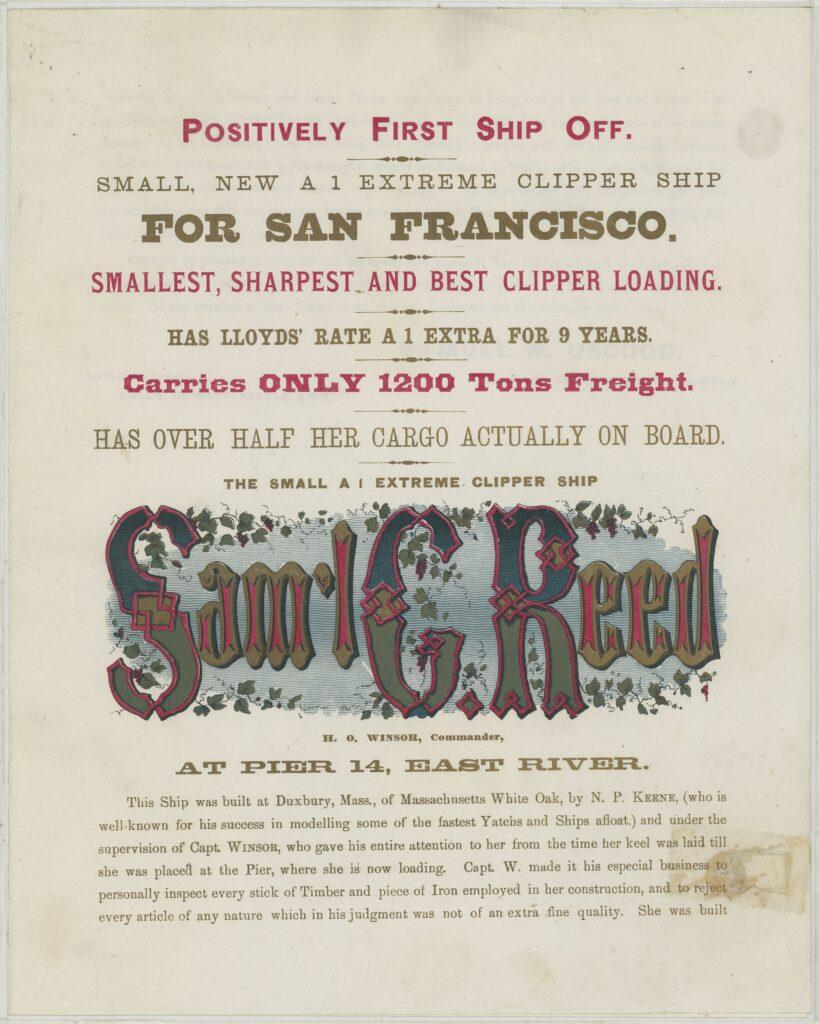
This broadside was printed in August 1969 for the clipper ship Samuel G. Reed. This colorful advertisement has a lot of information for potential passengers and shippers, including a detailed description of the ship’s construction that even specifies what kind of wood was used! Considering all of the information that is included, it may surprise you that this broadside does not say when the Samuel G. Reed is scheduled to depart. This is because most clipper ships headed for California didn’t run on a schedule at all.
The idea of a ship running on a predetermined schedule is taken for granted today, but until the Black Ball Line developed in the Seaport in 1818, a ship would depart whenever her master determined it would be most profitable. The day of departure would depend on how long it took to fill the ship with cargo and paying passengers. Though the heyday of the California clipper ships occurred decades after the idea of scheduled ships, or ocean liners, had revolutionized shipping, a clipper ship usually only departed once it had been “filled up.”
“Samuel G. Reed Broadside,” August 1869, paper, ink; Seamen’s Bank For Savings Collection, South Street Seaport Museum 1991.077.0060
Clipper ships headed for California were already at a disadvantage when it came to carrying cargo; they were designed for speed at the expense of cargo capacity, meaning that they could carry relatively little profit-making cargo (but promised merchants and passengers a quick passage compared to other types of ships.) Following a schedule that could leave a clipper ship half empty on the long voyage to San Francisco via Cape Horn was too great of a risk for most shipping companies in the California clipper trade.
The emergence of steam-powered vessels slashed transatlantic crossing times from months to as little as 10 to 17 days. Broadsides from dominant lines—such as the Anchor Line and the American Line—featured these key elements:
- Class Divisions: They detailed luxurious First Class accommodations (smoking rooms, grand staircases) while discretely offering passage for Third Class or Steerage passengers.
- Speed and Schedules: Marketing leaned heavily on technical marvels like screw propellers and iron hulls that made arrivals highly predictable.
- Ticket Prices: Flyers often provided tariffs for direct travel to Castle Garden (the precursor to Ellis Island) in New York, as well as onward railway vouchers to other US cities.
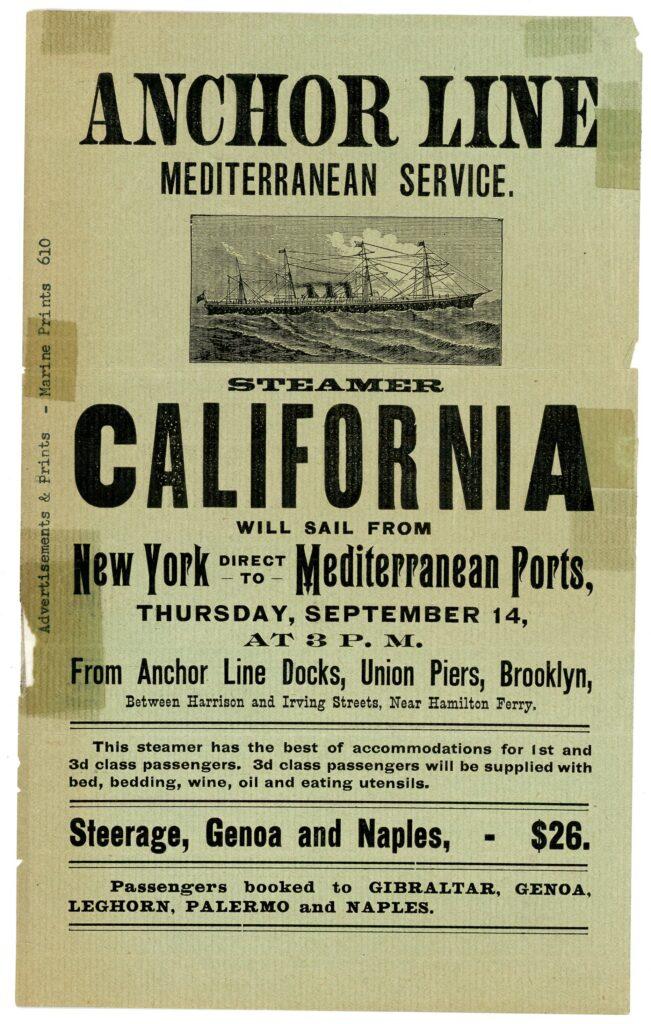
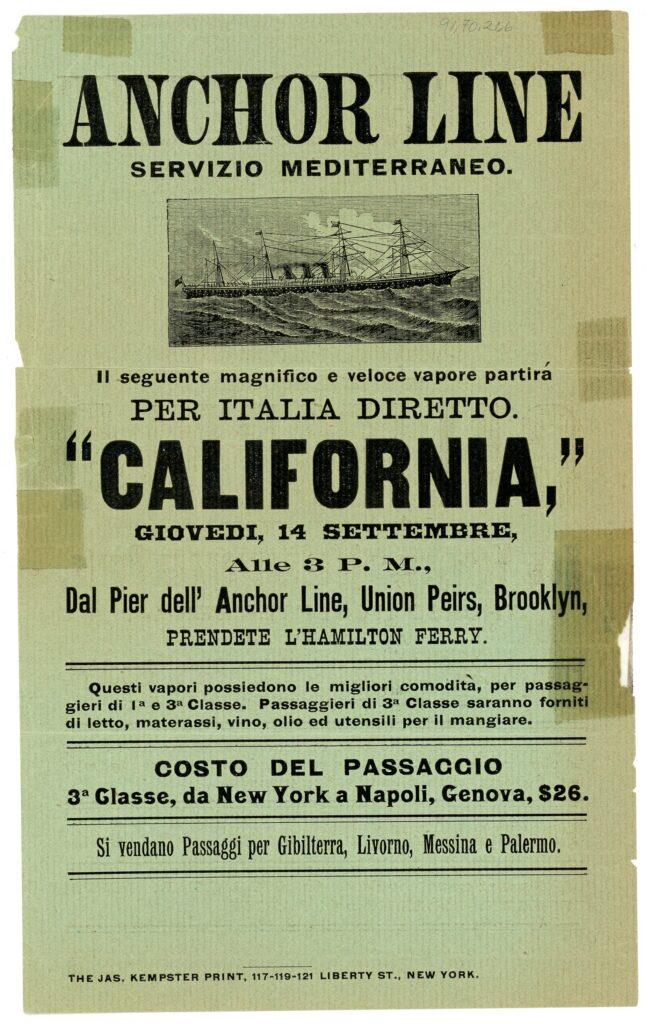
James Kempster, printer. “Anchor Line Mediterranean Service, Steamer California” ca. 1885. Peter A. and Jack R. Aron Collection, South Street Seaport Museum 1991.070.0266
What I find especially fascinating about this broadside is that it was printed on both sides—one in English and the other in Italian. This practical design meant the same notice could be displayed at either the port of departure or the port of arrival, making it useful to travelers and officials on both sides of the Mediterranean and Atlantic route.
The SS California was a pioneering 3,410-ton, three-masted steamship built by Alexander Stephen & Sons for the Scottish Anchor Line. During the 1880s, she regularly sailed between Glasgow, New York, and ports throughout the Mediterranean, carrying emigrants and cargo across the Atlantic. Constructed of iron and powered by a single-screw compound engine, California could reliably maintain a speed of about 13 knots. Her Mediterranean voyages, with stops in ports across Italy and Spain before continuing to the United States, made her a popular choice for thousands of emigrants seeking a new life in America.
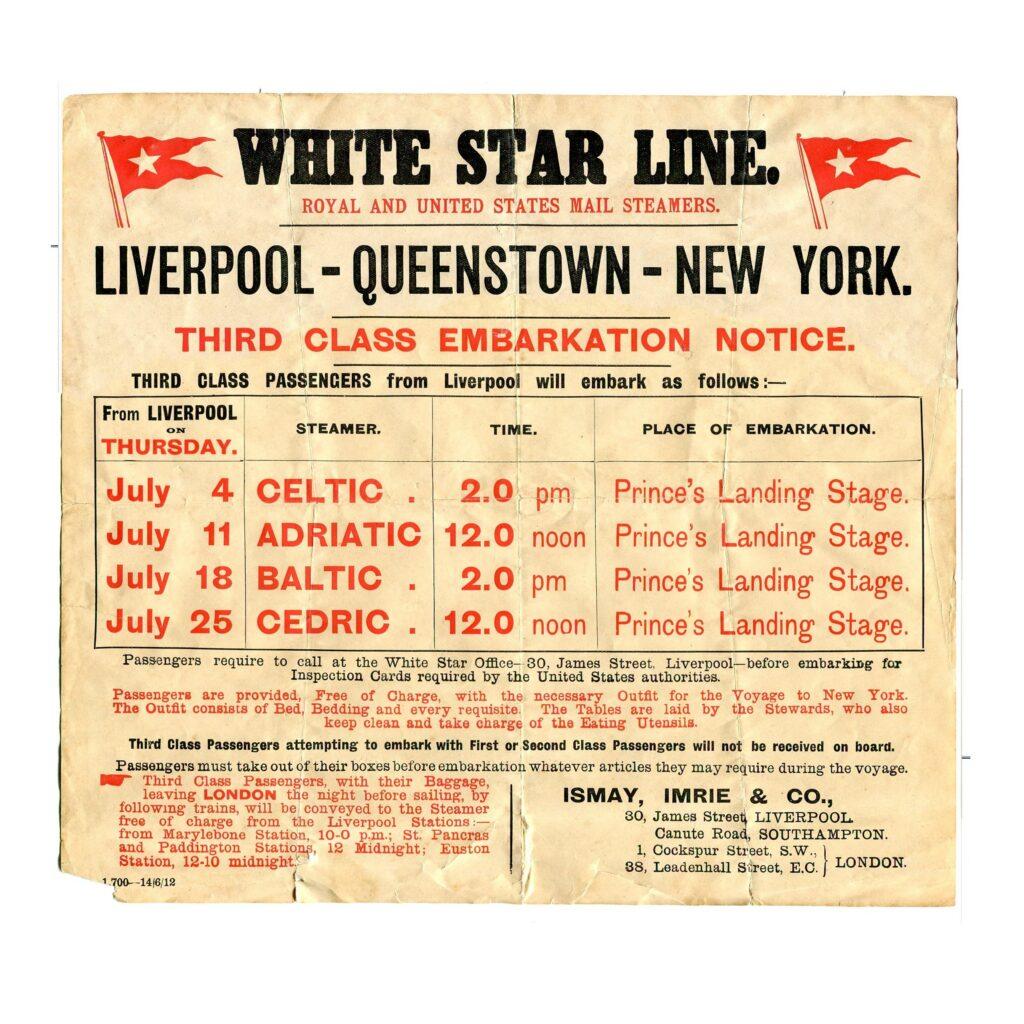
In 1912, this broadside was posted by the White Star Line to let Third Class passengers know when they could depart on an ocean liner for New York City. No doubt, many of these passengers were immigrants hoping to become American citizens, together with migrant workers and crew members. Aside from migrants and seamen, these massive transatlantic ocean liners would also have carried some of the wealthiest people of the time in First Class.
“White Star Line Third Class Embarkation Notice”, 1912. Peter A. and Jack R. Aron Collection, South Street Seaport Museum Foundation 1991.070.0262
One detail that always catches my eye is the fact that this broadside states that Third Class passengers could not embark without an Inspection Card and that “Third Class passengers attempting to board with First or Second Class passengers will not be received on board.”
The largest steamship companies (Cunard, White Star Line, Hamburg-American Line, North German Lloyd) had networks of thousands of agents selling tickets. Often tickets included ocean passage as well as European and American rail fare. A special agreement between the steamship companies and the railways allowed passengers to be booked through to their final destinations.
For migrants, buying the ticket began the process of reaching the port of embarkation. This could entail long rail journeys, possibly of hundreds of miles in distance, and multiple medical inspections. Immigrants were given an inspection card at their final medical exam before boarding the ocean liner for the United States. The inspection card would be needed to make it through Ellis Island.
Celebrating America 250
As I write this blog post, the Museum is presenting The Promise of Liberty: Words That Shaped a Nation, an exhibition that celebrates the power of the printed word in American history. One of my favorite lines from the exhibition reminds visitors that “The printed word is powerful. It amplifies the voices of individuals, organizations, and institutions.” That simple idea is really at the heart of this story.
As New York’s port grew into one of the busiest in the world, its printing industry flourished alongside it. New technologies transformed the trade. Large, often steam-powered cylinder presses produced books and newspapers in unprecedented numbers, while smaller, foot-powered presses turned out the everyday printed materials that kept the city running—broadsides, trade cards, billheads, receipts, and stationery.
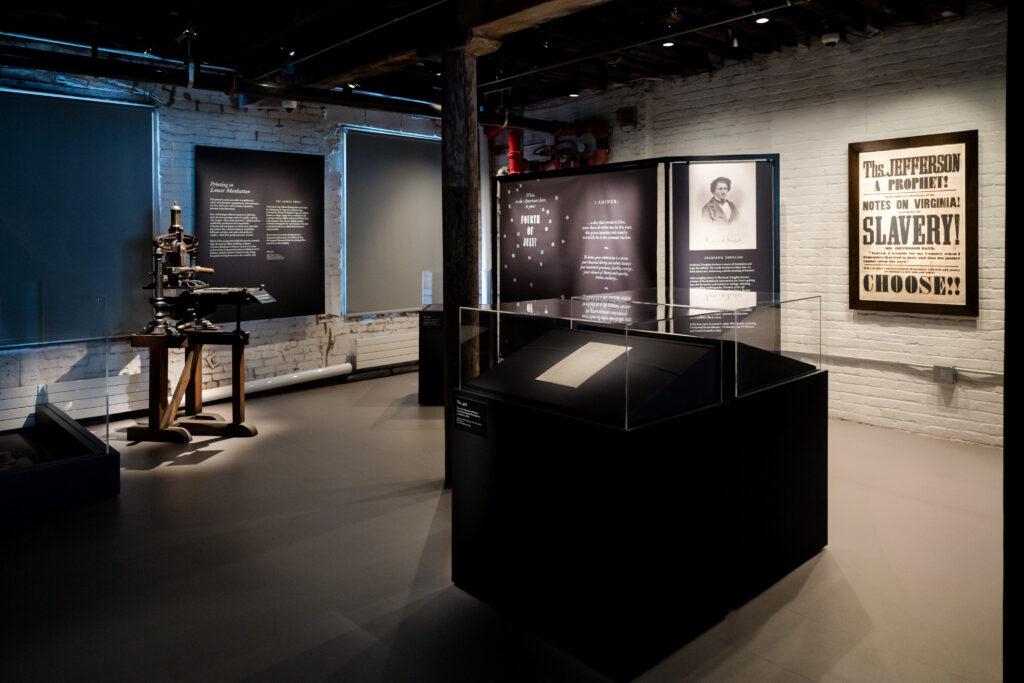
Photo credit Richard Bowditch
Much of this activity centered in Lower Manhattan. Printers wanted to be where the news happened: close to the docks, counting houses, taverns, and markets where people gathered, debated politics, bought and sold goods, and prepared for journeys across the Atlantic. They documented those conversations, advertised arriving cargoes, and helped shape the flow of information through the city.
One of the things I love most about The Promise of Liberty is how it brings these stories to life through rarely-exhibited documents and printed ephemera. Visitors encounter extraordinary pamphlets, treaties, personal correspondence, broadsides, and first printings of landmark texts that trace the nation’s ongoing pursuit of liberty—from the fight for religious freedom and the abolition of slavery to the movement for women’s suffrage.
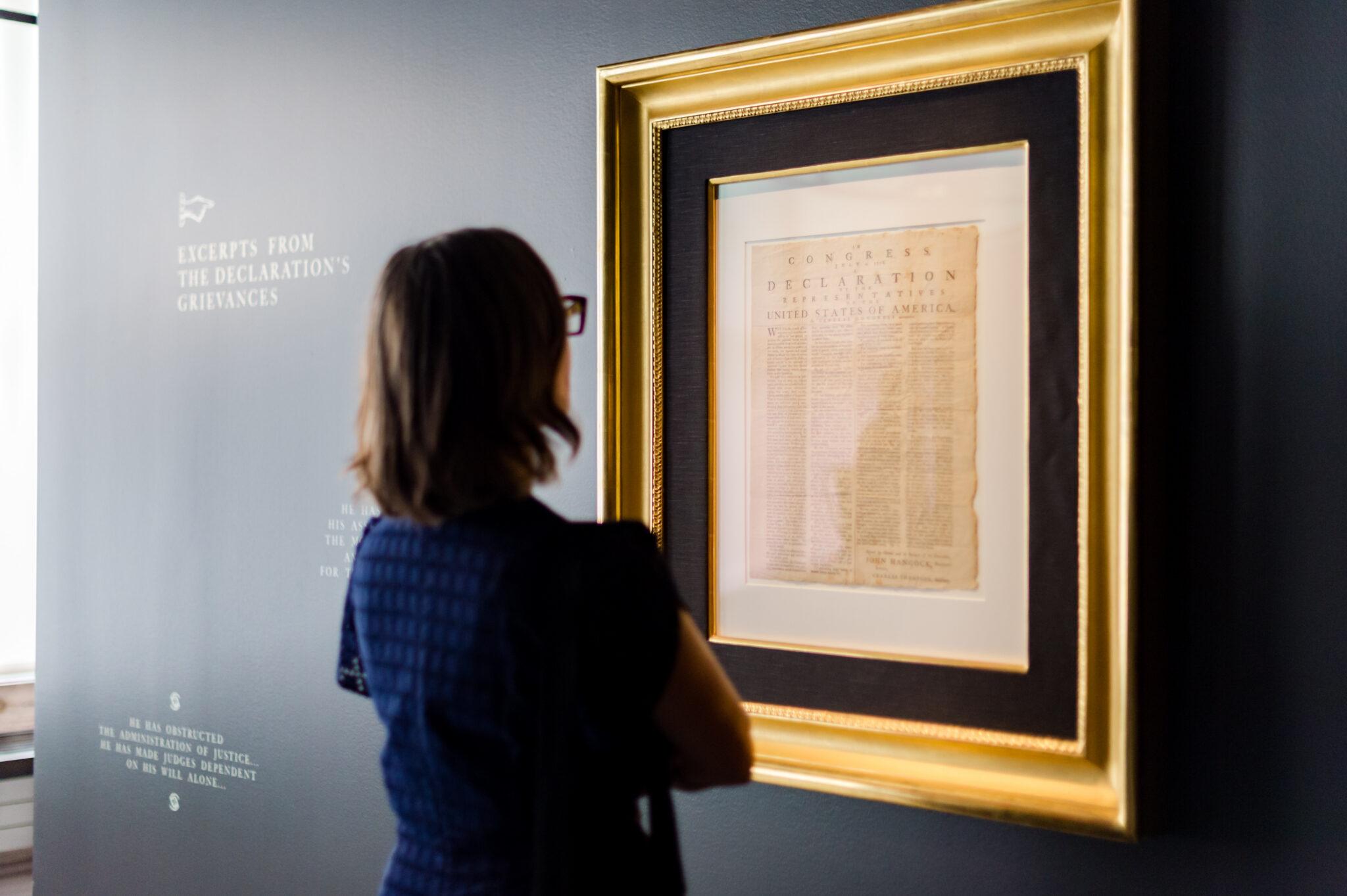
The exhibition also highlights New York’s unique role in that history. As the nation’s first capital and one of its most important ports and printing centers, Lower Manhattan became a place where ideas spread as quickly as ships arrived. Historic typefaces, working printing presses, and compelling broadsides reveal how printers didn’t simply record history—they actively shaped public opinion and carried new ideas throughout early America. You can admire a broadside printed over 250 years ago declaring the independence of the United States, close by a larger broadside including Thomas Jefferson’s (1743–1826) prophetic anti-slavery note, printed between 1840 and 1850, highlighting the unfinished promise of the Declaration of Independence, displayed a few steps away from a collection of smaller pieces of ephemera and broadsides from the early 20th century advocating for women’s representation in public office.
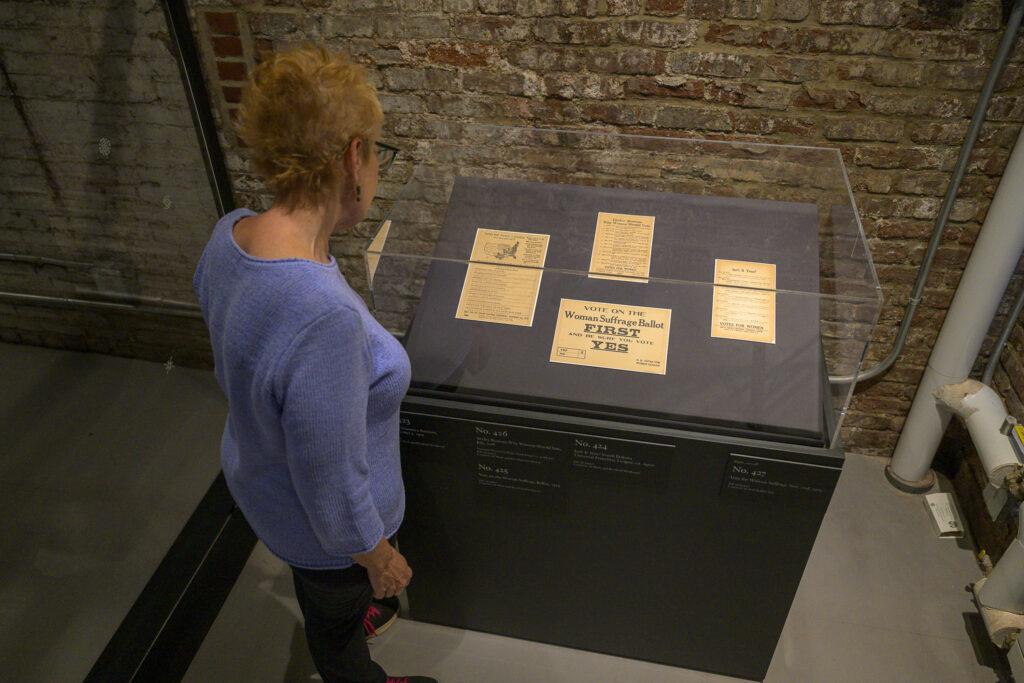
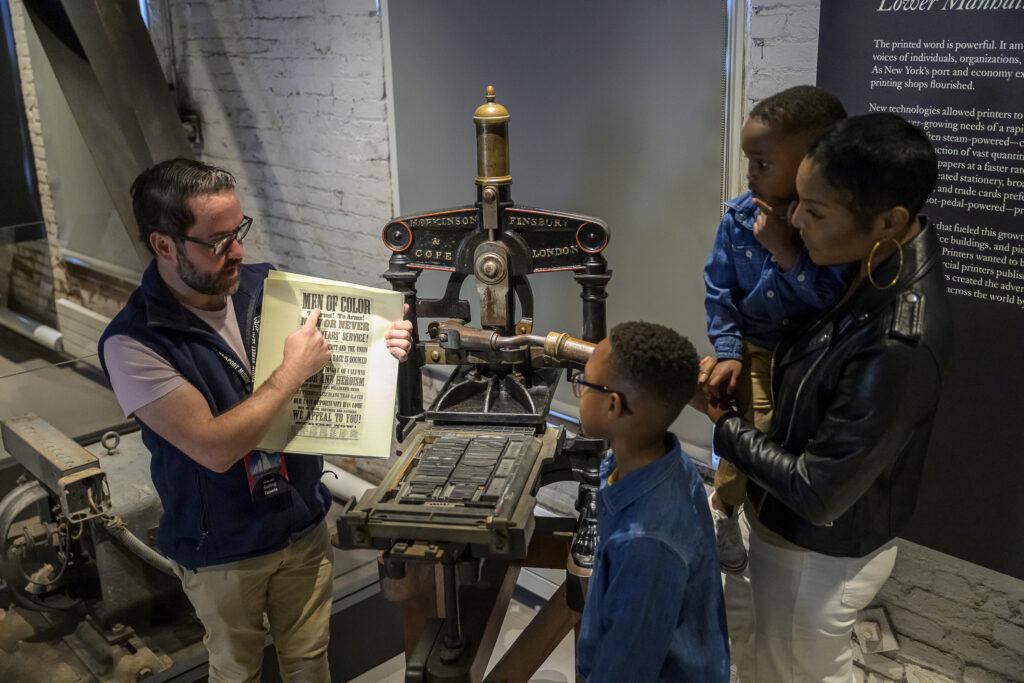
Photo credit Richard Bowditch
The Independence Broadsides
There is no single, authoritative “first” version of the Declaration of Independence. What many Americans think of as the original—the signed parchment preserved at the National Archives in Washington, D.C.—is actually a later ceremonial copy. It was engrossed for posterity and signed beginning on August 2, 1776, not on the day independence was declared.
The earliest public versions of the Declaration were something far more immediate and urgent: broadsides. Printed on single sheets of paper, designed for speed and circulation rather than preservation, they carried the news of independence across the colonies in the Summer of 1776.
The Dunlap Broadside
The first of these was printed by John Dunlap in Philadelphia on the night of July 4, 1776. Working through the night, Dunlap produced an estimated 200 copies, which were distributed quickly to Congress and dispatched to the States. These sheets—now known as the Dunlap broadsides—are the closest surviving witnesses to the moment independence was first made public.
Remarkably, the earliest official record of the Declaration survives in the handwritten Journals of the Continental Congress, compiled by Charles Thomson, which include a pasted-in Dunlap broadside. Today, only about 26 copies of this first printing are known to survive.
Mary Katharine Goddard’s 1777 Broadside
While Dunlap’s printing announced the Declaration, it did not yet list the signers. That changed in January 1777, when Congress commissioned a new official broadside. Printed by Mary Katharine Goddard (1738–1816), this version is historically significant as the first to include the names of the signers, formally attaching individual accountability to the act of independence. A signed copy, bearing the names of John Hancock and Charles Thomson, was sent to each of the States, reinforcing its authority and ensuring its widespread dissemination.
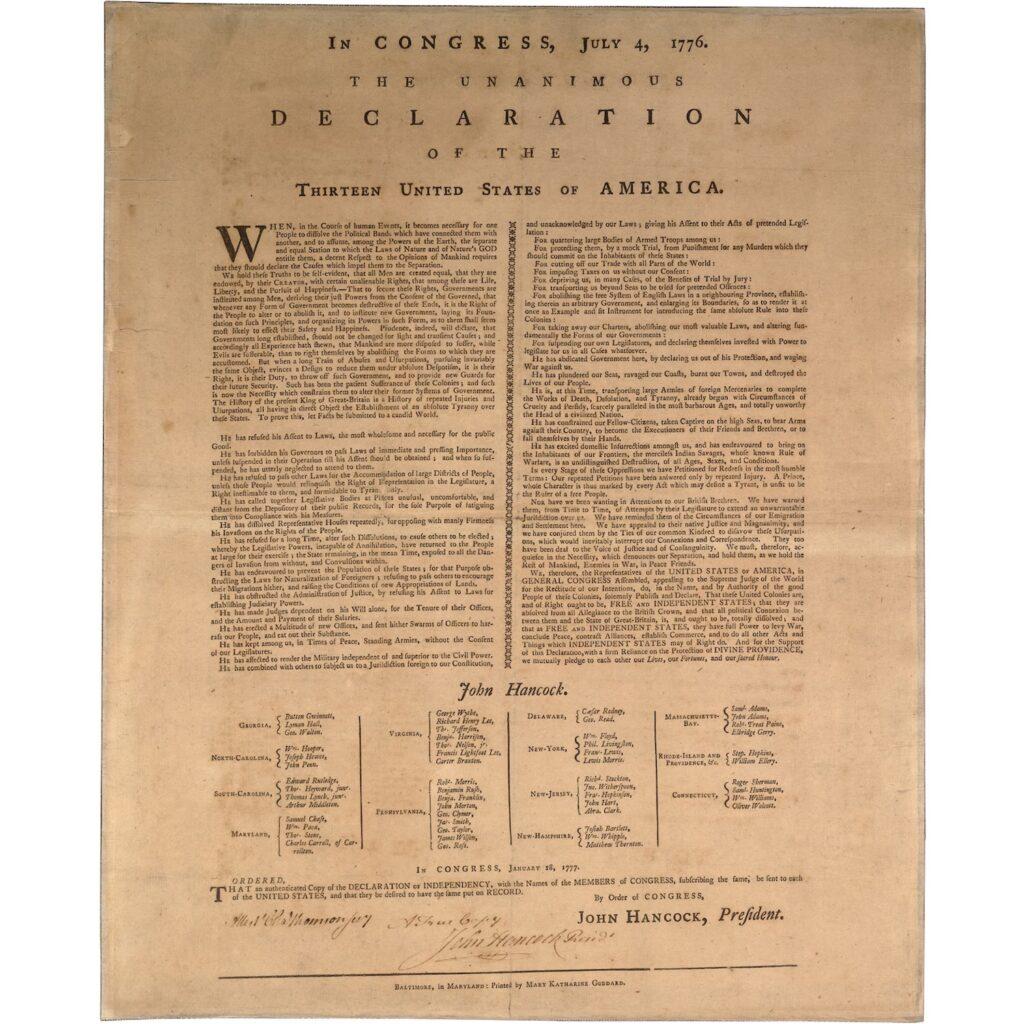
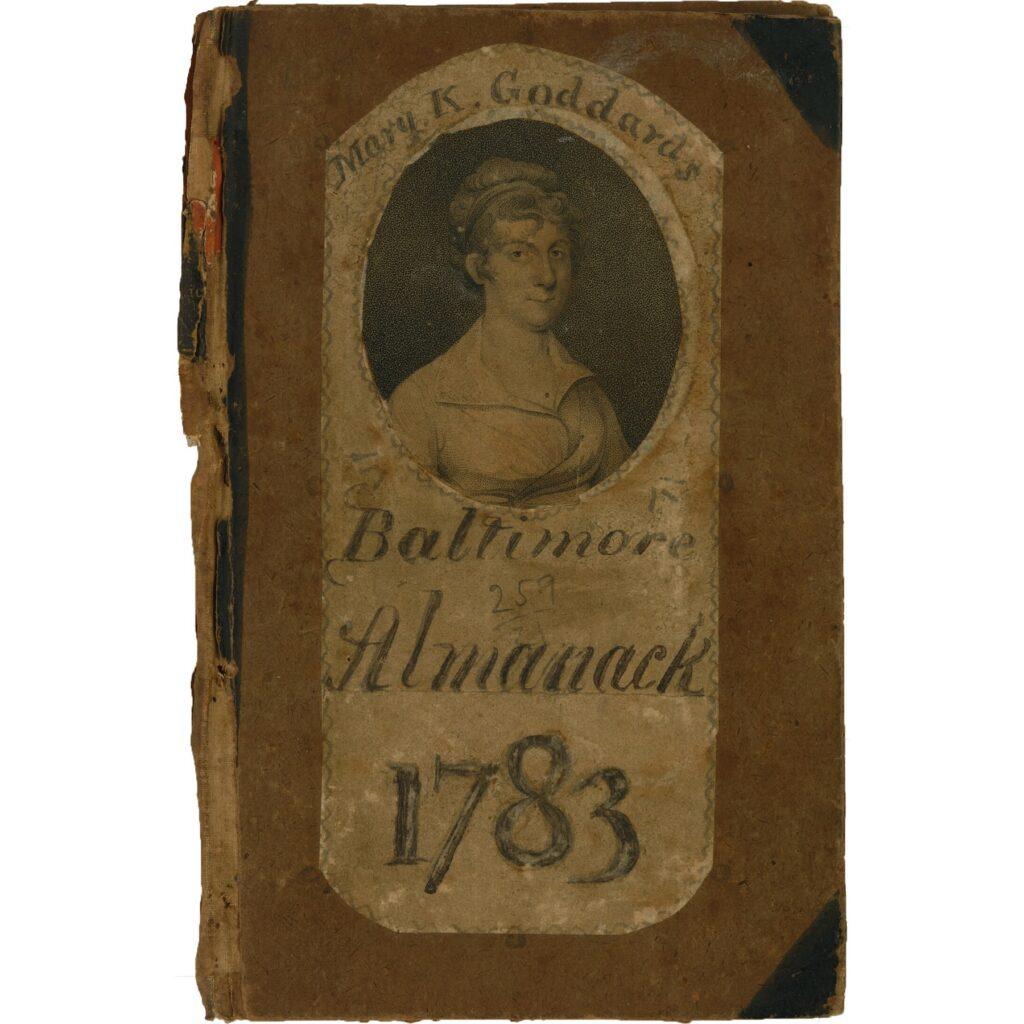
Left: The Declaration of Independence printed with the names of the signers. Courtesy of the Library of Congress, Rare Book and Special Collections Division, Continental Congress & Constitutional Convention Broadsides Collection.
Right: Goddard on the cover of the Baltimore Almanack from 1783. Courtesy of the John Carter Brown Library at Brown University.
Goddard was appointed Baltimore’s postmaster in 1775, and may have been the first woman postmaster in colonial America. She originally served under the leadership of Postmaster General Benjamin Franklin (1706–1790), who oversaw the newly independent colonial postal system established by her younger brother, William Goddard (1740–1817). Not only was Goddard in charge of a post office serving a major commercial city, but she was also an accomplished printer and publisher, successfully publishing her brother’s newspaper, The Maryland Journal, from 1774 to 1784. Recognizing the excellence of her paper, in 1777 Congress granted Goddard the honor of publishing the first copy of the Declaration of Independence with all the signatories listed.
A flood of print: newspapers, broadsides, and local versions
In the weeks that followed, the Declaration took on many printed forms. What survives today represents only a fraction of what was produced in 1776, as printers across the colonies rushed to reproduce the news.
In New York, John Holt (1721–1784) published the Declaration in the July 11 issue of the New York Journal, alongside an official broadside that incorporated New York’s resolution supporting independence—helping transform what had been a revolutionary declaration into a unanimous colonial stance.
In Massachusetts, Ezekiel Russell (1743–1796) printed a broadside that included the State Council’s July 17 order mandating further distribution. His edition emphasized public reading, instructing that the Declaration be sent to every parish and proclaimed in churches, embedding independence into civic and religious life. The document is on display as part of The Promise of Liberty exhibition through this Summer.
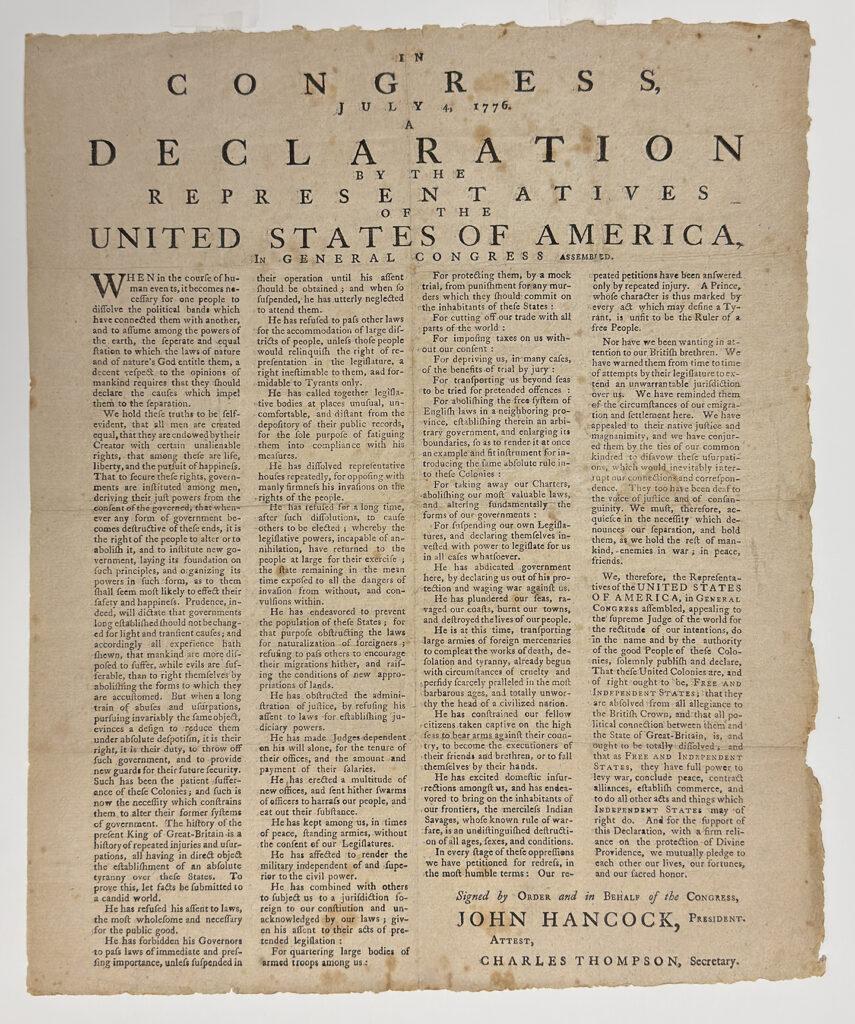
“The Declaration of Independence” ca. July 14–16, 1776. Letterpress on paper. Courtesy of an Anonymous Collector 2026.PoL.MC.001
Other variations followed. Some editions were typeset with unusual spacing or ornamentation; others introduced errors or localized additions. One Philadelphia printing even appeared in German blackletter type, reflecting the linguistic diversity of the colonies and the urgency of reaching as wide an audience as possible.
Broadsides in Motion
These sheets did not sit still. The Declaration did not arrive in the colonies as a single fixed text—it arrived as a moving object, constantly reprinted, adapted, and reinterpreted as it spread. That circulation also explains why so few early broadsides survive. Most were handled, posted, discarded, or worn away by use. Their survival today is as much an accident as preservation.
The rarity of these documents has made them objects of fascination and, at times, controversy. Claims of rediscovered copies continue to surface, such as the widely-discussed Dunlap broadside reportedly found behind a painting purchased for a few dollars at a flea market in the 1980s.
Questions also persist around early print culture itself. Scholars have debated details of typesetting and attribution, including arguments raised in Frederick Goff’s The John Dunlap Broadside: The First Printing of the Declaration of Independence (1976). Even foundational assumptions about “firstness” in print culture remain open to interpretation.
More recently, discoveries such as a reported Ezekiel Russell broadside identified at the Berkshire Museum in 2022 remind us that the documentary record of the Revolution is still not fully settled.
Why Broadsides Matter
A broadside is not just a format—it was an instrument of revolution. Unlike the ceremonial parchment or later printed histories, broadsides represent the Declaration as it first functioned in the world: urgent, reproducible, and public.
As the United States celebrates its 250th anniversary of the adoption of the Declaration of Independence in 1776, these fragile sheets offer a different way of understanding independence—not as a single fixed document, but as a network of printed texts moving rapidly through an emerging nation.
In that sense, the Declaration of Independence was never one thing. It was many things at once: Dunlap’s midnight printing, Goddard’s authoritative list of signers, Holt’s newspaper account, Russell’s parish instruction, and countless other versions now lost to time. Together, they form the true printed origin of American independence.
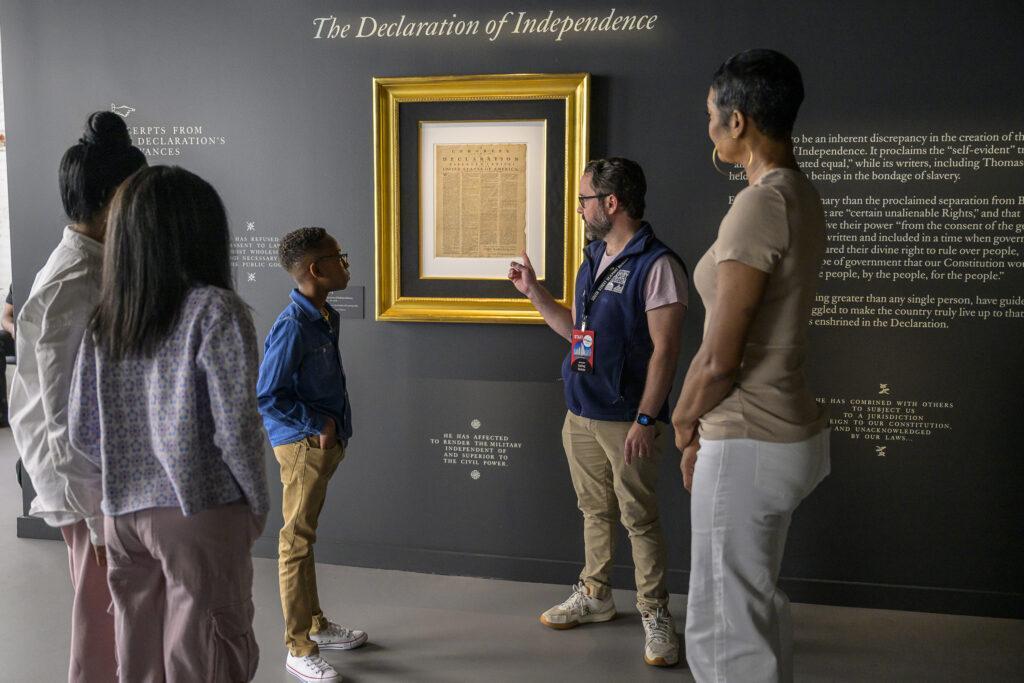
Photo credit Richard Bowditch
Additional readings and resources
Nineteenth-Century Passenger Agents within the Local and Global Commerce of Maritime Mobility, by James Boyd. Mainsheet, A Journal of Multidisciplinary Maritime Studies, Issue 2, Maritime Technologies, Livelihoods, and Economies.
Street Advertising in Early 20th Century Manhattan by Michelle Kennedy, Collections and Curatorial Assistant. A Collections Chronicles Blog, South Street Seaport Museum, July 30, 2020.
Modern Broadside Printing at Bowne & Co., by Christine Picone, Designer at Bowne & Co.. A Seaport Museum Blog, October 22, 2020.
Which Version is This, and Why Does it Matter? Declaration Resources Project, Harvard Graduate School of Education https://declaration.fas.harvard.edu/resources/which-version-and-why
March Highlight: Mary Katherine Goddard. Declaration Resources Project, Harvard Graduate School of Education https://declaration.fas.harvard.edu/blog/march-goddard