

Your Questions Answered
A Collections Chronicles Blog
by Martina Caruso, Director of Collections and Exhibitions
June 18, 2026
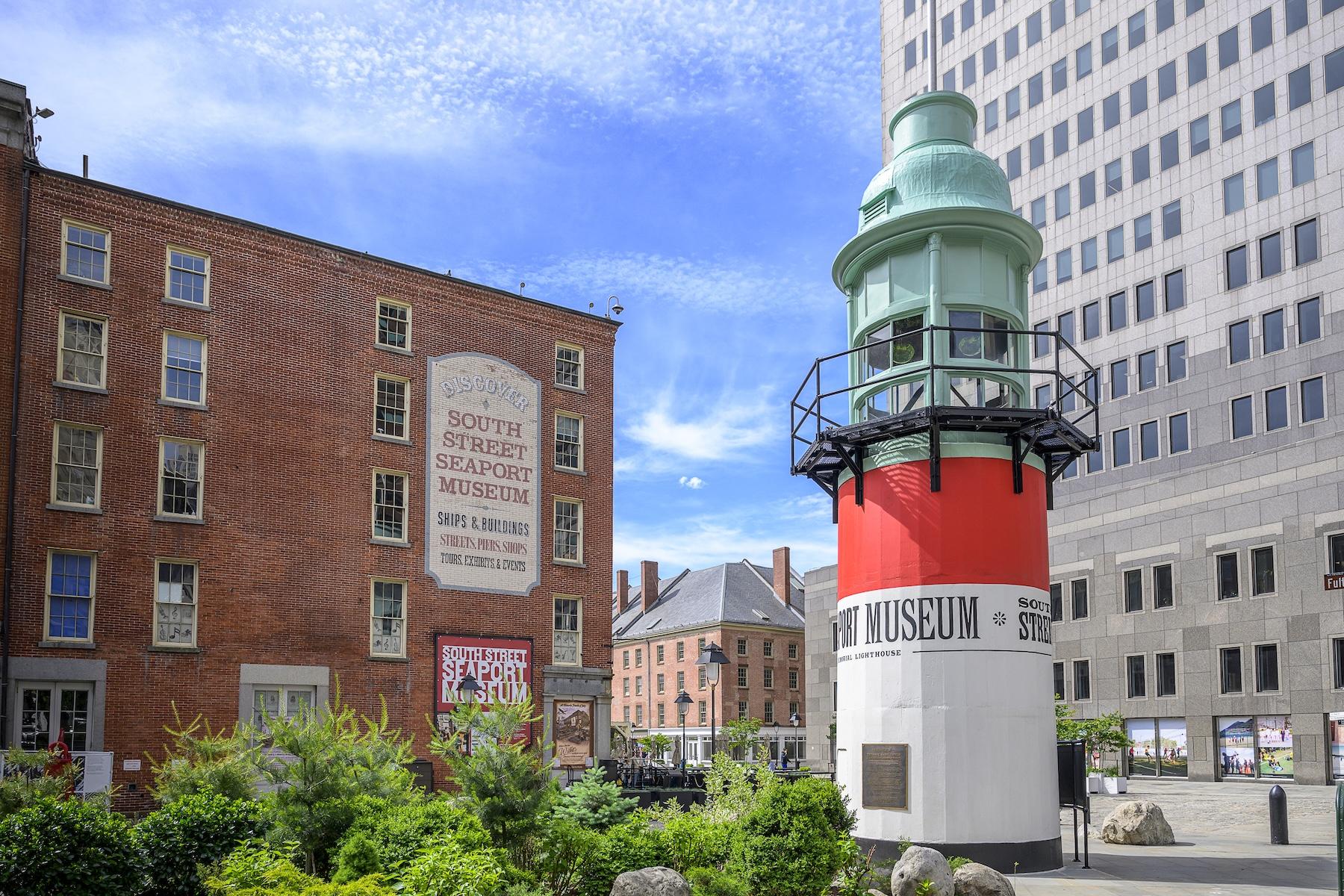
Since the Titanic Memorial Lighthouse has been unveiled in the neighborhood, following its extensive restoration, visitors have been stopping to admire it—and asking a lot of questions. Some wonder why they can no longer see the time ball. Others are curious about the green lights glowing inside the lantern, the colorful bands painted around the base, or why the structure bears the name of the South Street Seaport Museum so prominently.
These questions are exactly what we hoped the restoration would inspire. Every decision made during the project was rooted in historical research, a close look into archival photographs, inspection of surviving artifacts, and getting a deeper understanding of the lighthouse’s long and complex history. In many cases, the restoration revealed stories that had been forgotten for decades and challenged assumptions about how the structure originally functioned.
I hope this blog post answers some of the questions we hear most often and provides a closer look at the research, design process, and preservation work that brought the Titanic Memorial Lighthouse back to life.
Where Is the Time Ball?
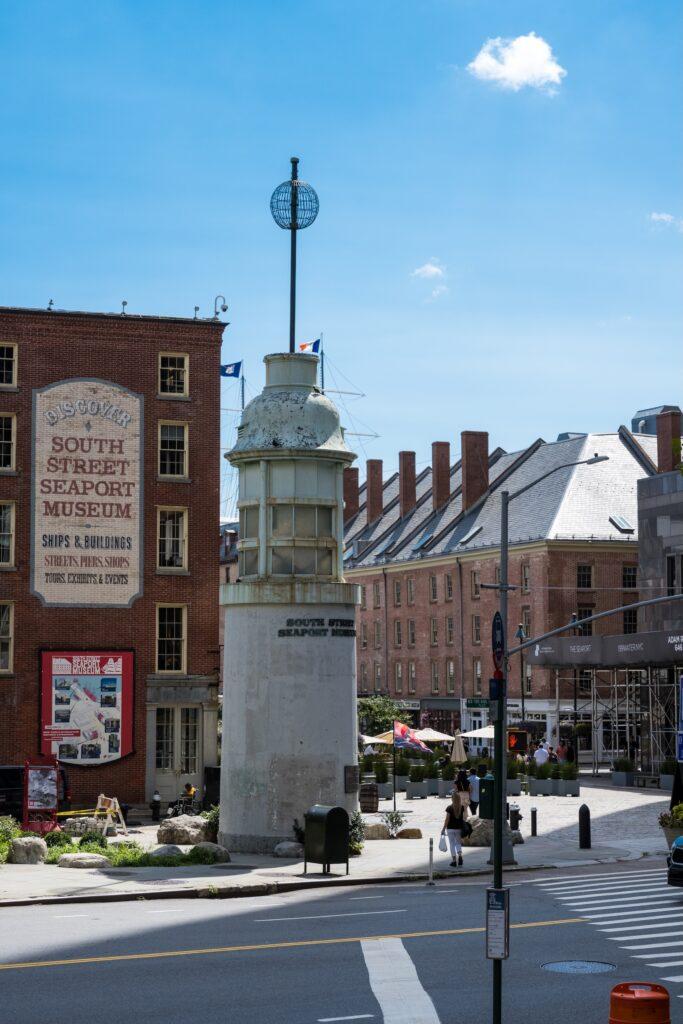
One of the questions we’ve heard most often since the restoration of the Titanic Memorial Lighthouse is: Where is the time ball? For more than four decades, visitors to the Seaport became accustomed to seeing the skeletal frame of a time ball mounted atop the mast. While it evoked the appearance of a historic maritime time signal, its purpose was largely decorative. The structure lacked the mechanical components necessary to function as a true time ball, and it remained fixed in place. As part of the recent restoration, however, the Museum sought to return this important feature to its original purpose, transforming it from a static ornament into a working maritime time signal once again.
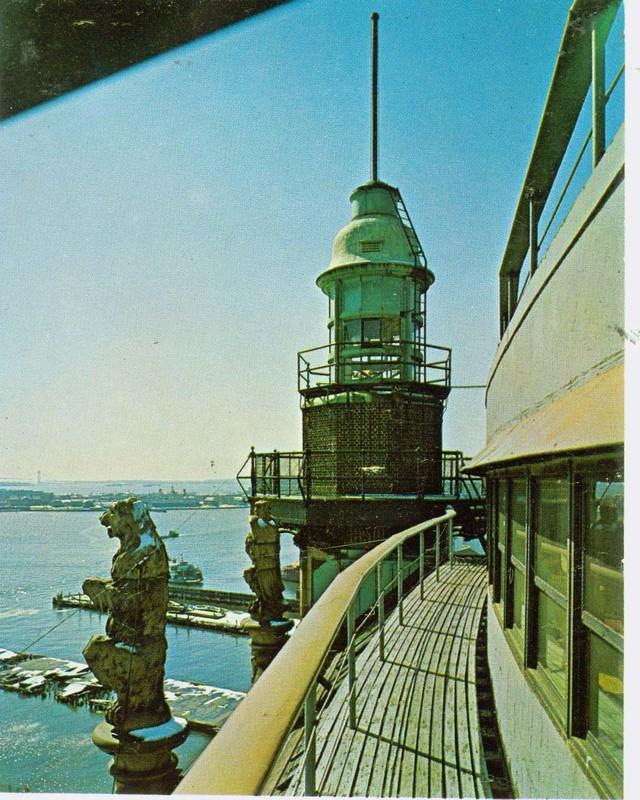
Left: Titanic Memorial Lighthouse on top of the Seamen’s Church Institute, ca. 1940s. South Street Seaport Museum Archives.
Center: Titanic Memorial Lighthouse, 2021. Photo Richard Bowditch.
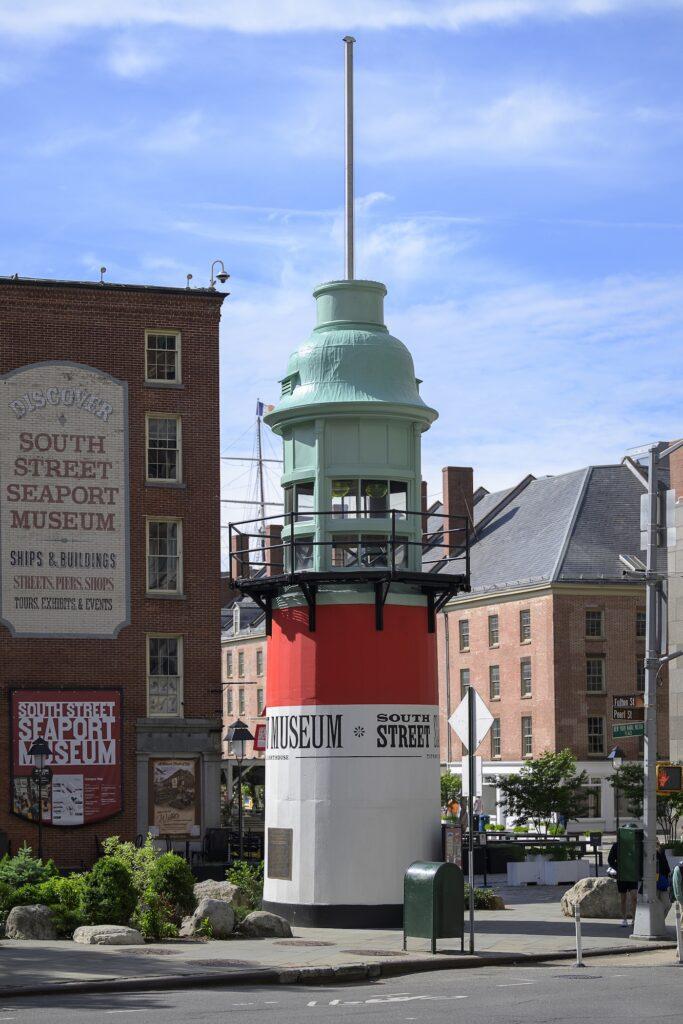
Right: Titanic Memorial Lighthouse, 2026. Photo Richard Bowditch.
To understand why the ball is no longer visible at the top of the mast, it helps to understand how a time ball works. Time balls were among the most important navigational aids of the 19th century. First introduced in Portsmouth, England, they provided ships in harbor with a reliable visual method for setting their marine chronometers, which were essential for determining longitude at sea. Shortly before noon each day, a large ball would be raised to the top of a mast. At the appointed moment, it would drop, allowing mariners throughout the harbor to synchronize their timepieces. Before the widespread adoption of radio signals, this simple system provided one of the most accurate ways for sailors to verify time while in port.
During the restoration project, the Museum worked to recreate a functioning time ball system while preserving the historic character of the lighthouse. The original skeletal ball, which had weathered the elements atop the structure for decades, was carefully removed and accessioned into the Museum’s collections, where it is now preserved as a historic artifact. Detailed measurements of the original were taken, allowing the restoration team to design a new ball that closely reflects its historic appearance while accommodating the requirements of the new operating mechanism.
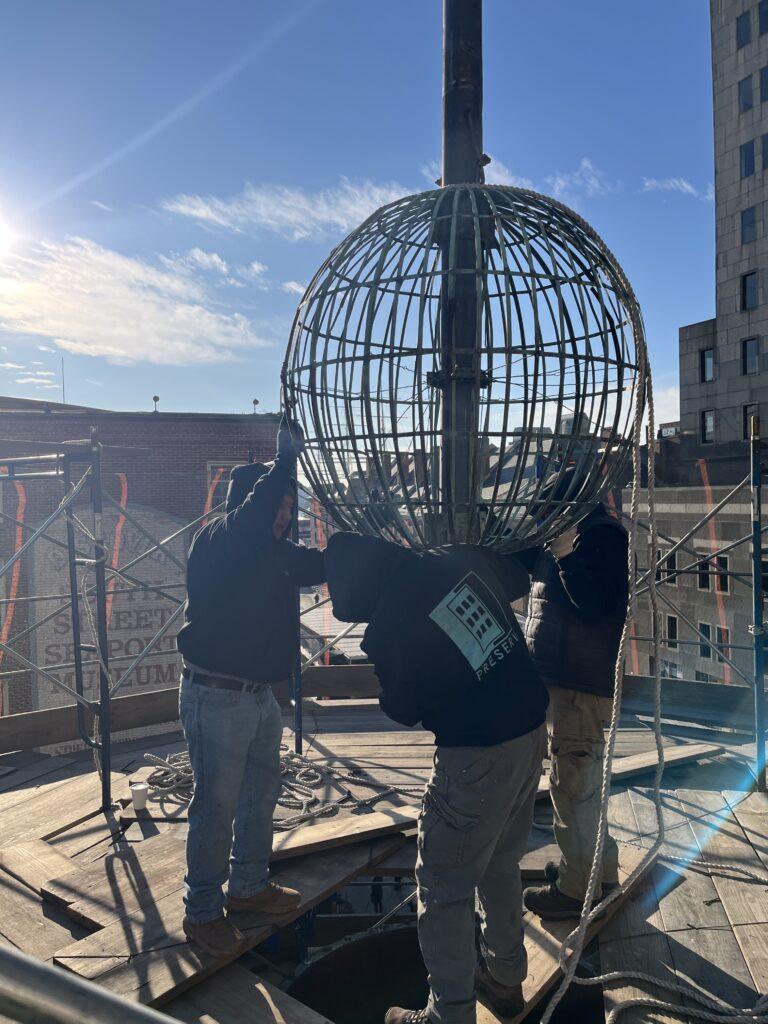
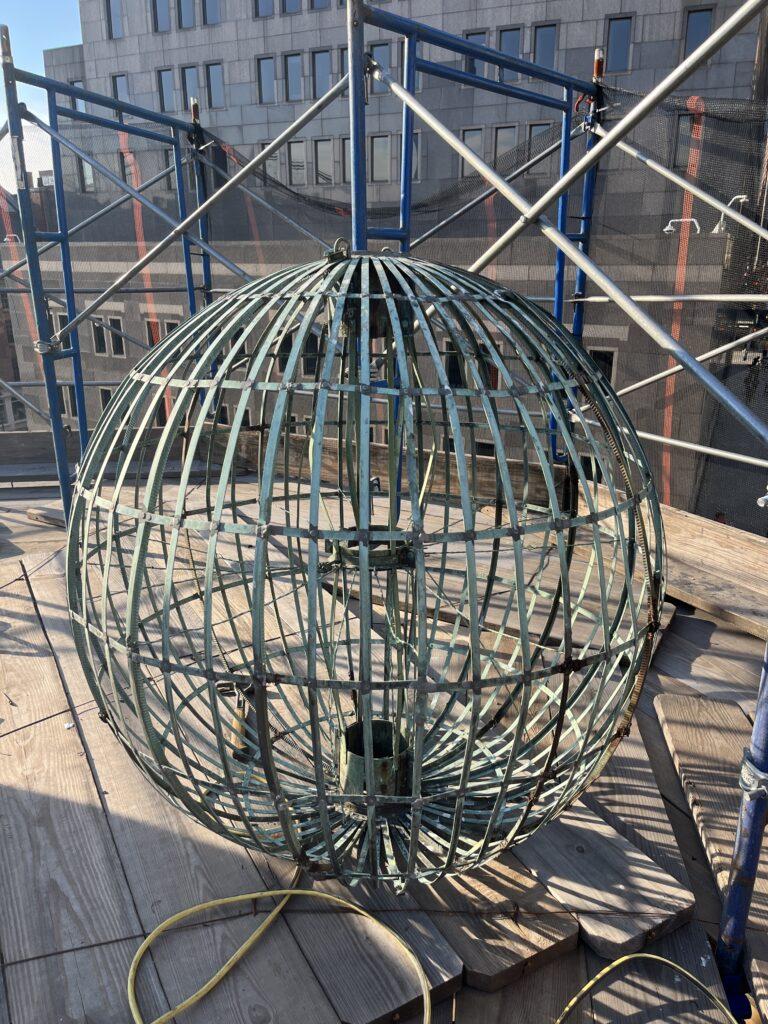
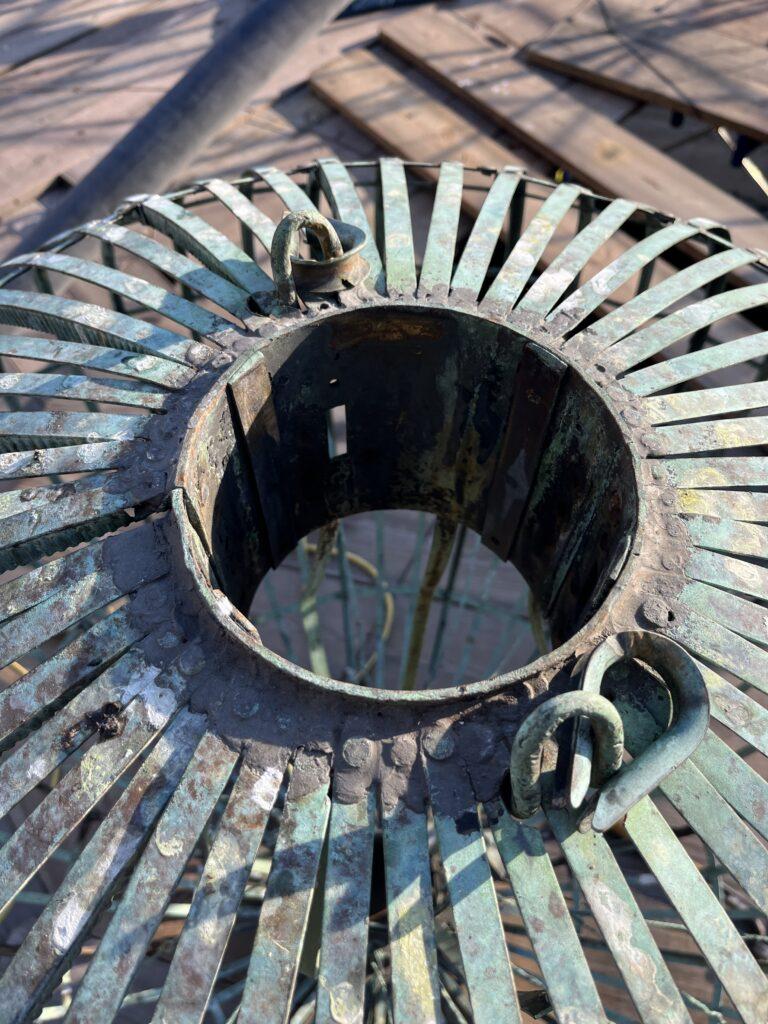
The new ball was inspired by the construction of historic time balls, which were often fabricated from metal frameworks wrapped in leather or canvas and coated with protective finishes. Based on the dimensions of the original and the needs of the new rigging system, the replacement was designed as two separate halves joined around the mast and operating mechanism. This approach allowed the ball to function safely while maintaining the visual character of the historic structure.
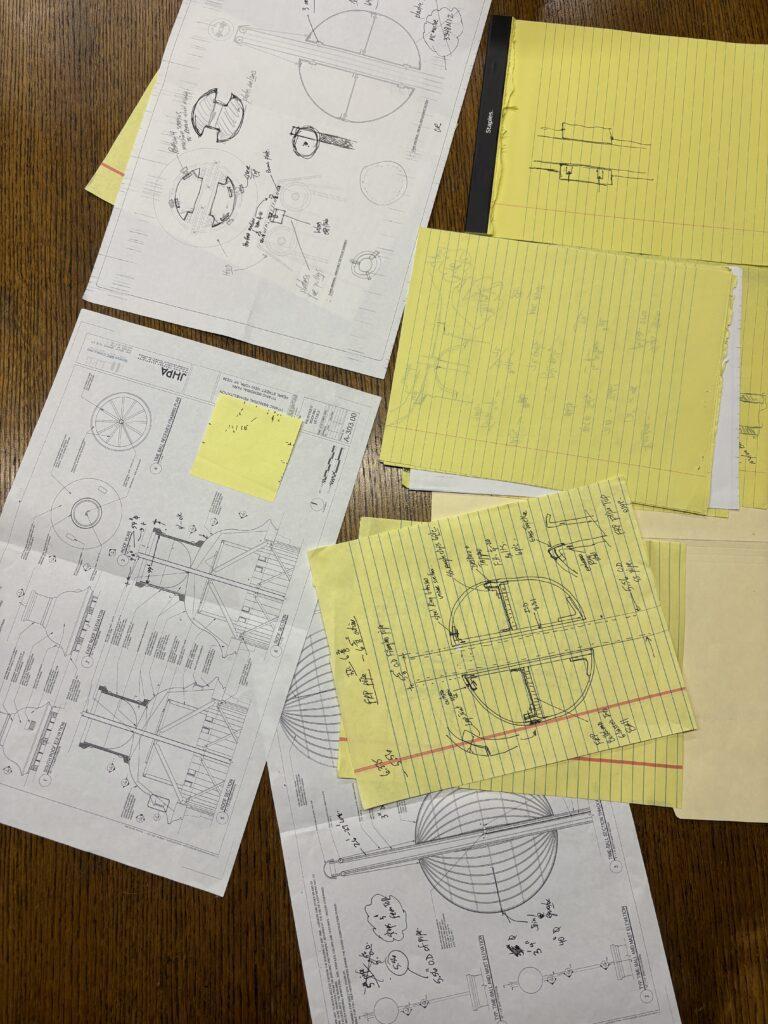

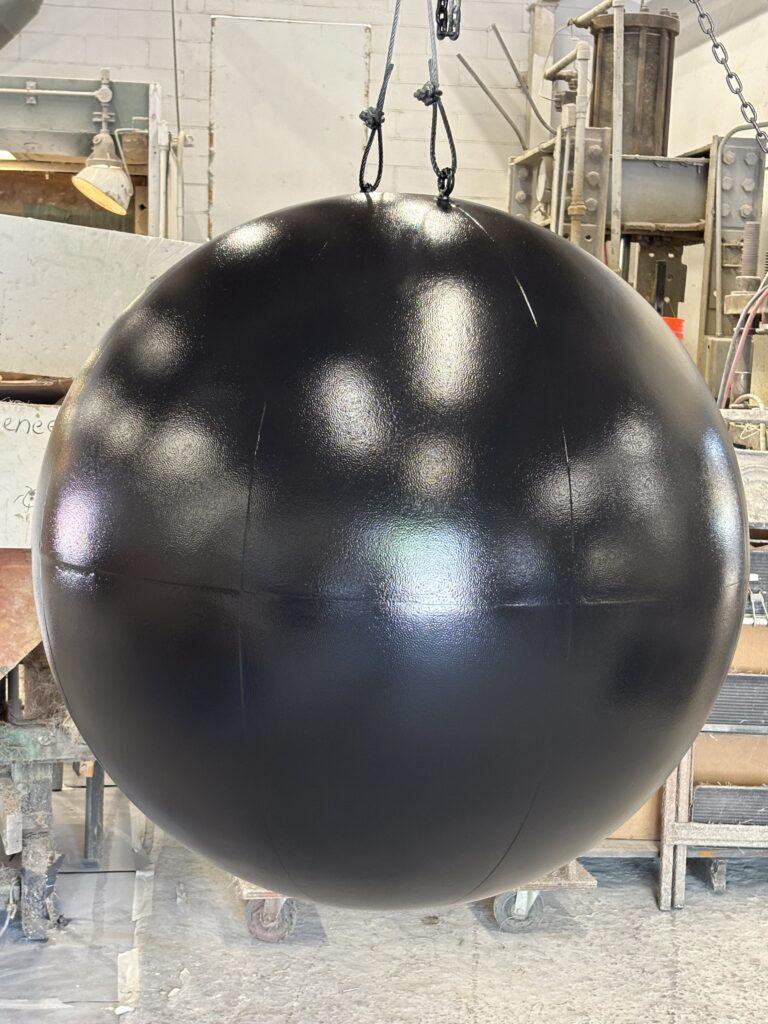
Sketches and studio visit at custom fiberglass manufacturer Seal Fiberglass.
So where is the time ball today? Unlike the previous decorative version, the restored ball is not intended to remain visible at all times. When not in operation, it is housed within the receiver at the top of the lantern, where it is protected from the elements. Each day around noon, the ball is raised and lowered through the newly-installed rigging system, recreating the historic function of the lighthouse as a public time signal. Once the demonstration is complete, the ball returns to the receiver, where it remains until the next activation.
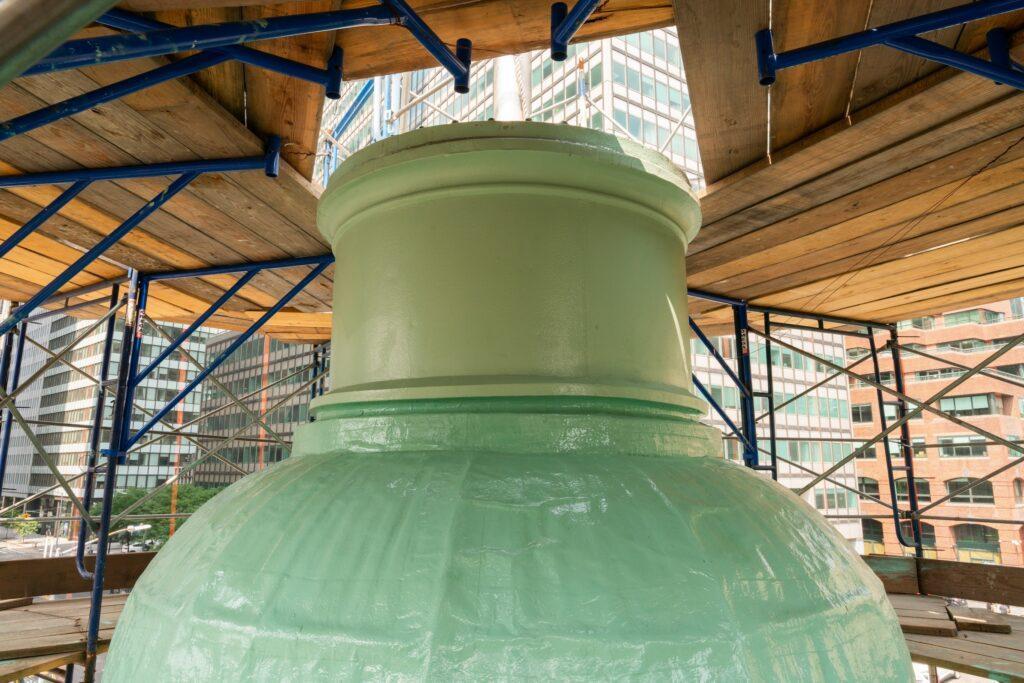
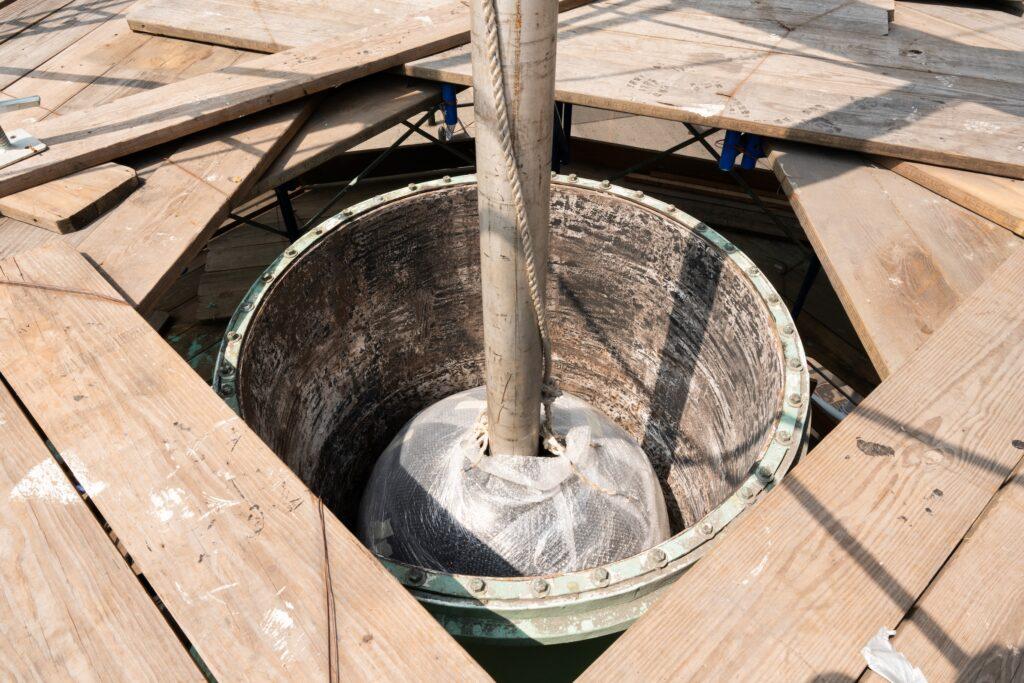
By concealing the ball when it is not in use, the restoration protects both the mechanism and the historic structure while allowing visitors to experience the time ball as it was originally intended—as a moving instrument rather than a fixed ornament. So, if you find yourself in the Seaport before noon, take a minute to pause in front of the Titanic Memorial Lighthouse and look up! The ball will slowly rise up the mast a few minutes before 12-noon, then drop down right after, ultimately returning to the receiver.
Why Are the Lights Green?
Following questions about the time ball, we have regularly been receiving inquiries about the lights. Why are there three light bulbs? Why is it green?
Based on the research conducted for the restoration, the Titanic Memorial Lighthouse originally featured three powerful electric lamps mounted inside the lantern. Since this was never intended to be registered as a functioning lighthouse, the lights were not intended to function as a traditional lighthouse beam. Instead, they were designed to create a highly-visible, fixed glow that could be seen throughout New York Harbor, serving as a beacon for sailors approaching the Seamen’s Church Institute, where it was originally mounted. Historical records describe the lantern as containing three Cooper Hewitt lamps of 2,500 candlepower each, making the memorial one of the most conspicuously illuminated features on the waterfront when it was dedicated in 1913.
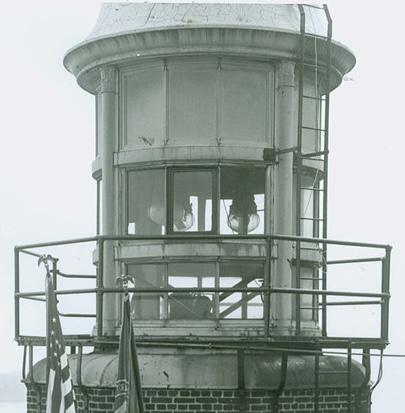
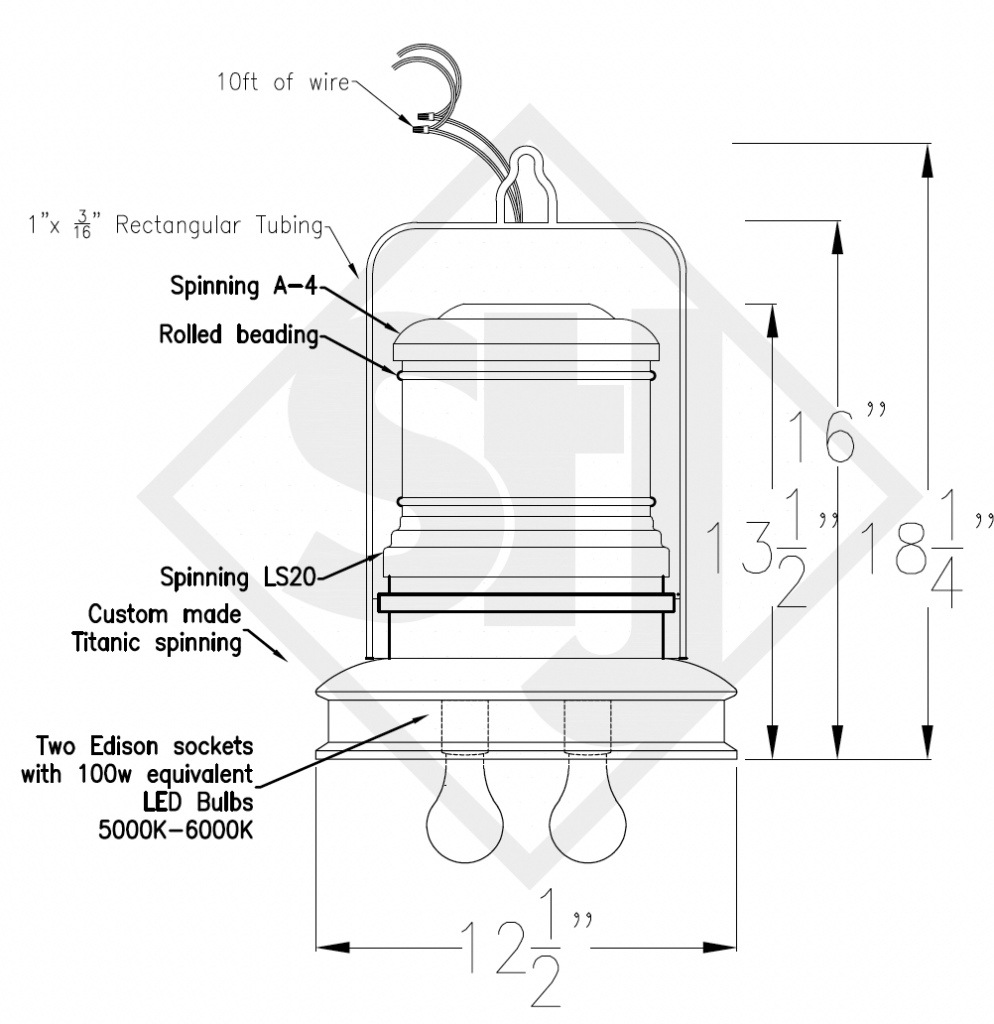
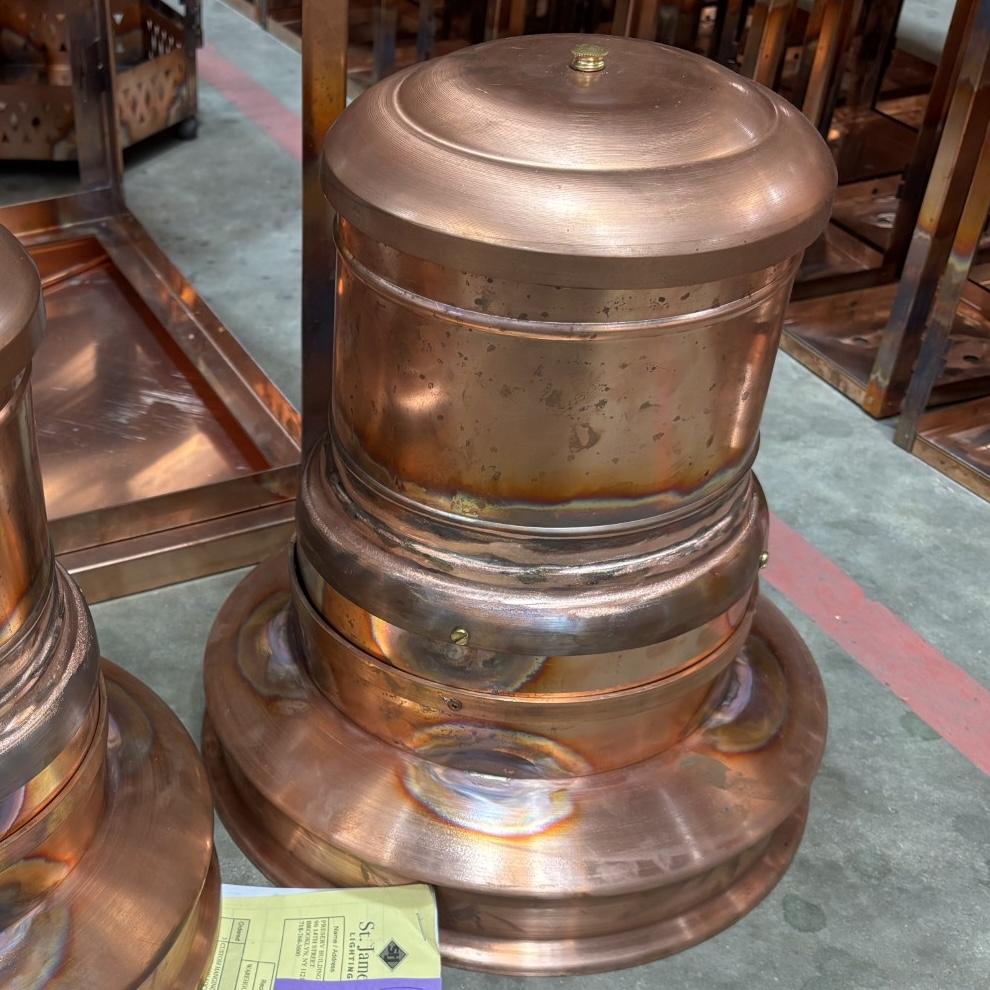
Left: Detail from an archival image depicting the Titanic Memorial Lighthouse’s lantern with three lights fixtures inside.
Center: Replica Light Fixture design.
Right: Replica Light Fixture being produced.
The original choice of green light was deliberate. During the planning of the memorial, the Seamen’s Church Institute wanted a light that would be immediately recognizable and distinct from other navigational aids in the harbor. Because lighthouses and navigation lights already relied on established color conventions, the Institute sought and received approval from federal authorities in Washington to display a fixed green light from the tower. Contemporary accounts noted that sailors would recognize the distinctive glow as a sign that they had reached the Seamen’s Church Institute—a place offering services, assistance, and a welcoming refuge for mariners arriving in New York.
Recent restoration research also solved a long-standing mystery about how that green color was achieved. The original lantern used early mercury-arc lighting technology, which naturally produced a soft chartreuse-green light. Historic photographs confirmed that the lantern’s glass globes were clear rather than green, meaning the color came from the light source itself rather than colored glass. In recreating the lighting system today, the restoration team carefully studied the original fixtures and historic documentation to reproduce the distinctive green glow that made the memorial visible across the harbor more than a century ago.
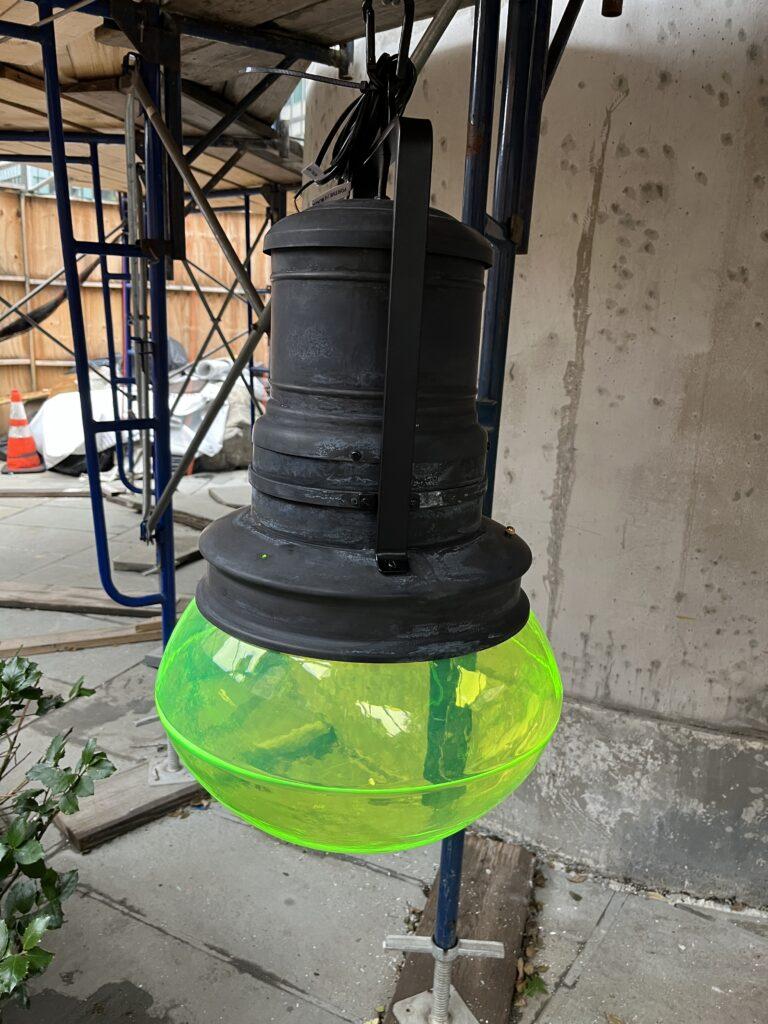
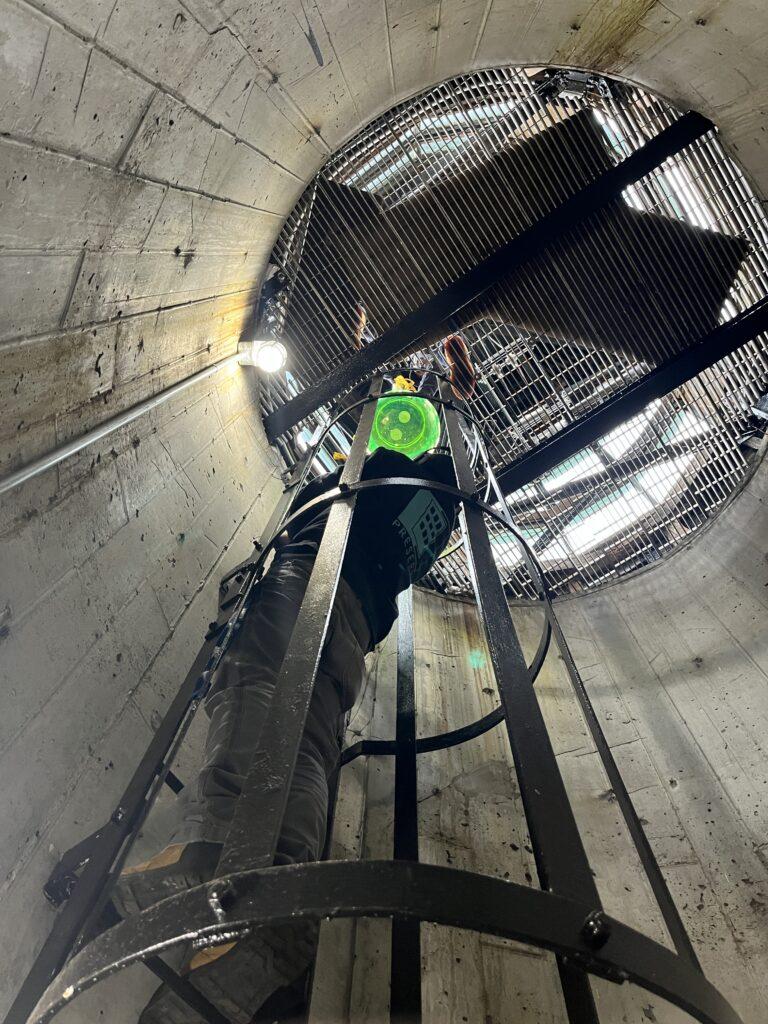
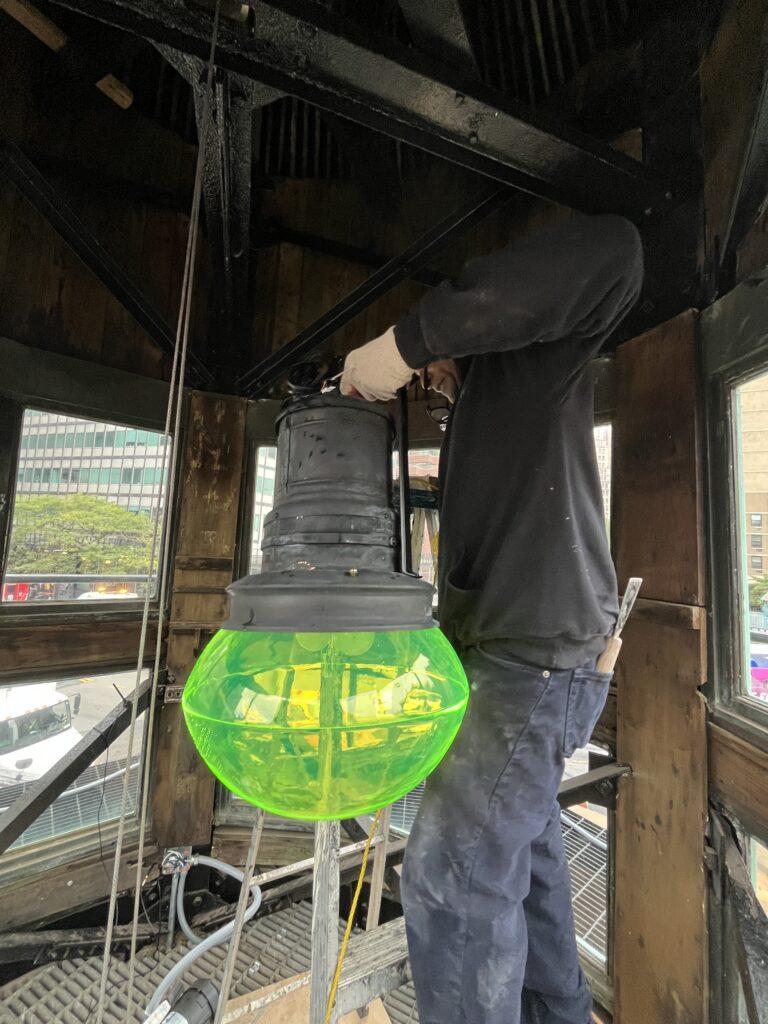
So the short answers are:
- There are three bulbs because the original memorial used three high-powered lamps.
- The Titanic Memorial Lighthouse glows green today because, historically, the Seamen’s Church Institute intentionally chose a unique green beacon that sailors could recognize from miles away as a sign of home and safe harbor.
Can I Get Inside?
Many lighthouses are closed to visitors—or offer only limited access—because they are active aids to navigation, contain operational equipment, or are located in environments that present safety concerns.
In the case of the Titanic Memorial Lighthouse, the interior still houses functioning systems with high-powered electrical equipment that require secure access. Additionally, like many historic lighthouses, the original ladder is extremely narrow and steep, and lacks modern safety features such as handrails.
Research also shows that the Titanic Memorial Lighthouse was never intended to host visitors inside. Archival photographs from the Seamen’s Church Institute depict commemorative gatherings taking place on the exterior landing rather than within the lighthouse itself.
If climbing a lighthouse is on your to-do list, we recommend visiting the Fire Island Lighthouse on Long Island, where visitors can climb the tower to enjoy panoramic views, or the Twin Lights Historic Site in New Jersey, which offers access to one of its lighthouse towers and spectacular views of New York Harbor!
What’s Up with the Color Bands and Lettering on the Base?
The colorful bands and bold lettering on the lighthouse base are rooted in the visual language of the Seaport and Lower Manhattan in the 19th century. When developing the design, we first turned to the South Street Seaport Museum’s collections, which include thousands of photographs documenting the neighborhood’s past and more than 2,000 cases of historic printing type.
Many of these early photographs reveal a common design strategy: typography arranged in horizontal bands across façades. In the busy commercial district that once lined the waterfront, every available surface was an opportunity to communicate. Building owners used stripes of text to announce their names, advertise their businesses, and describe the goods and services available inside.
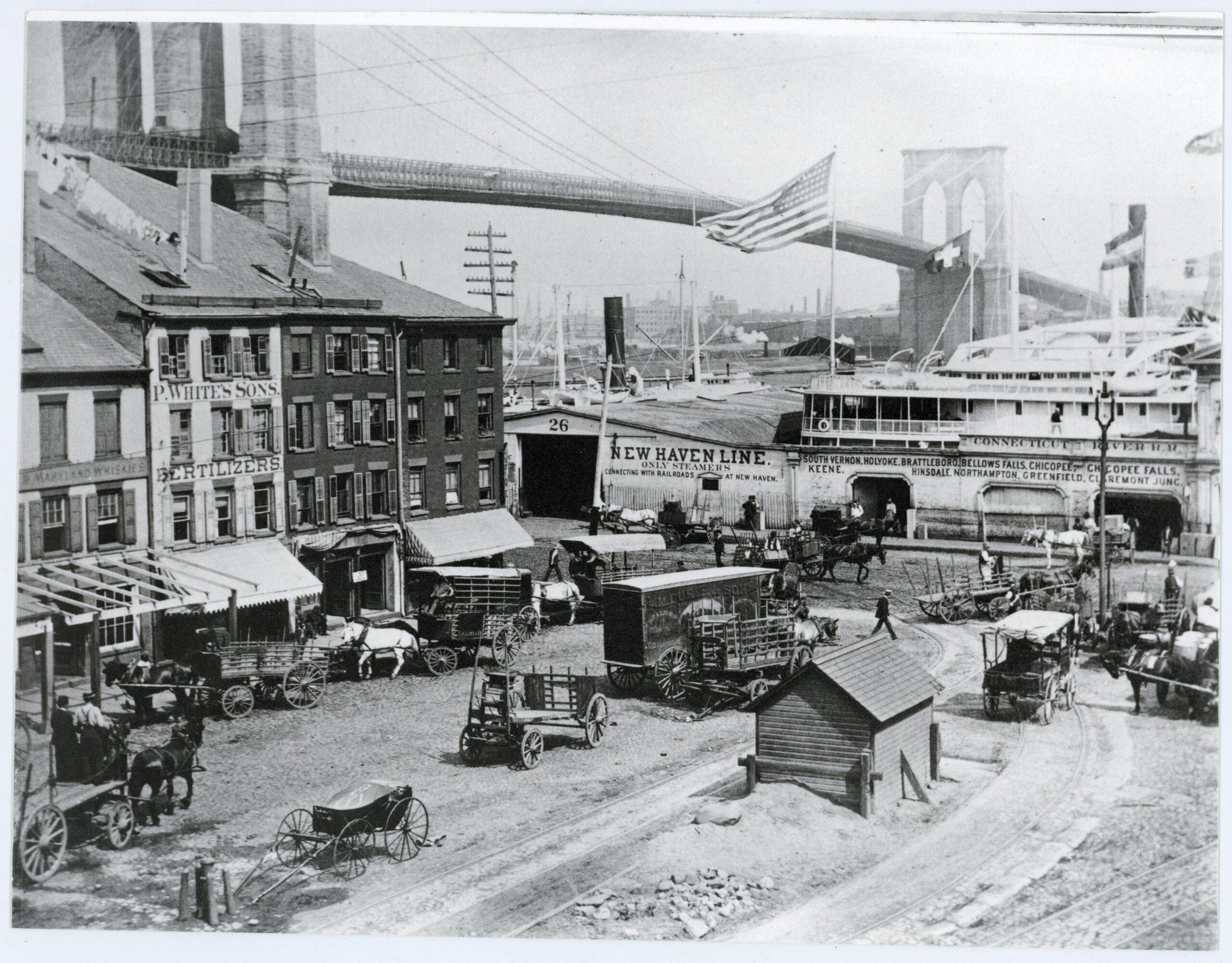
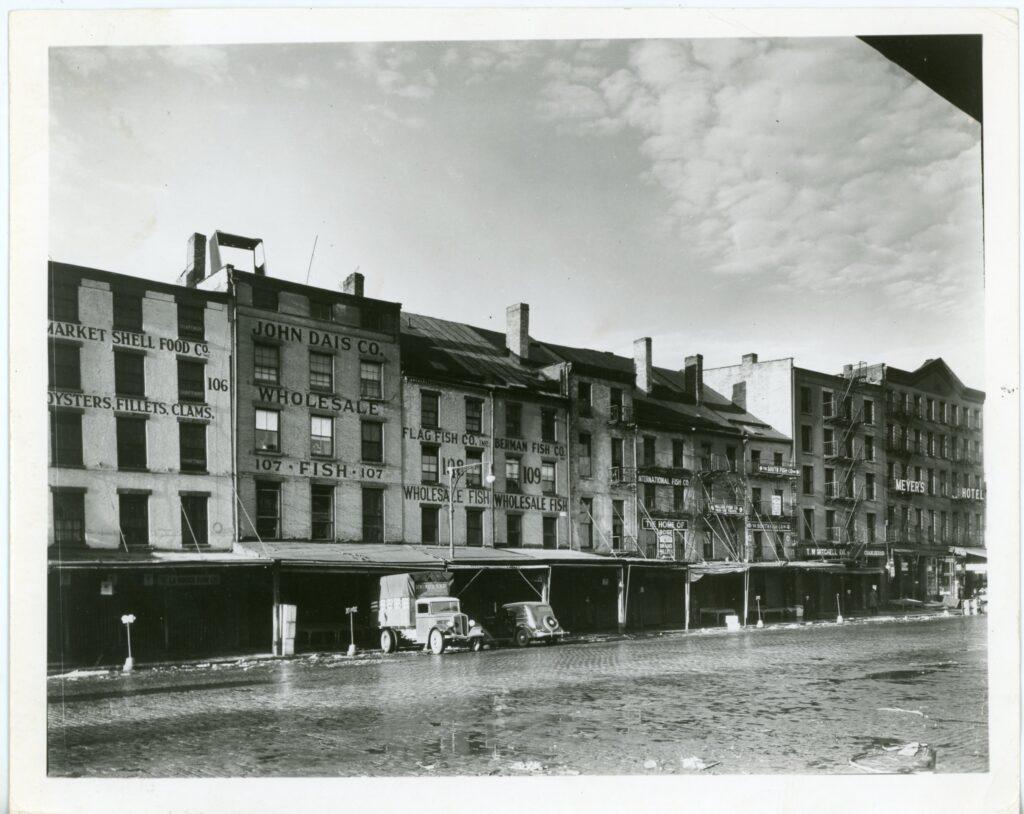
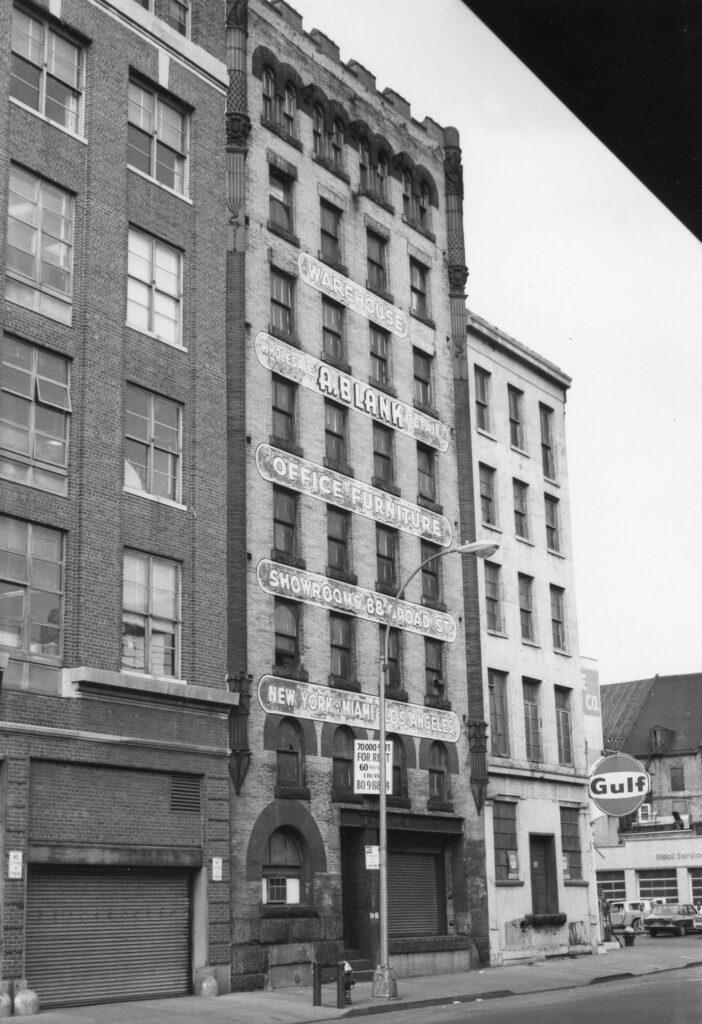
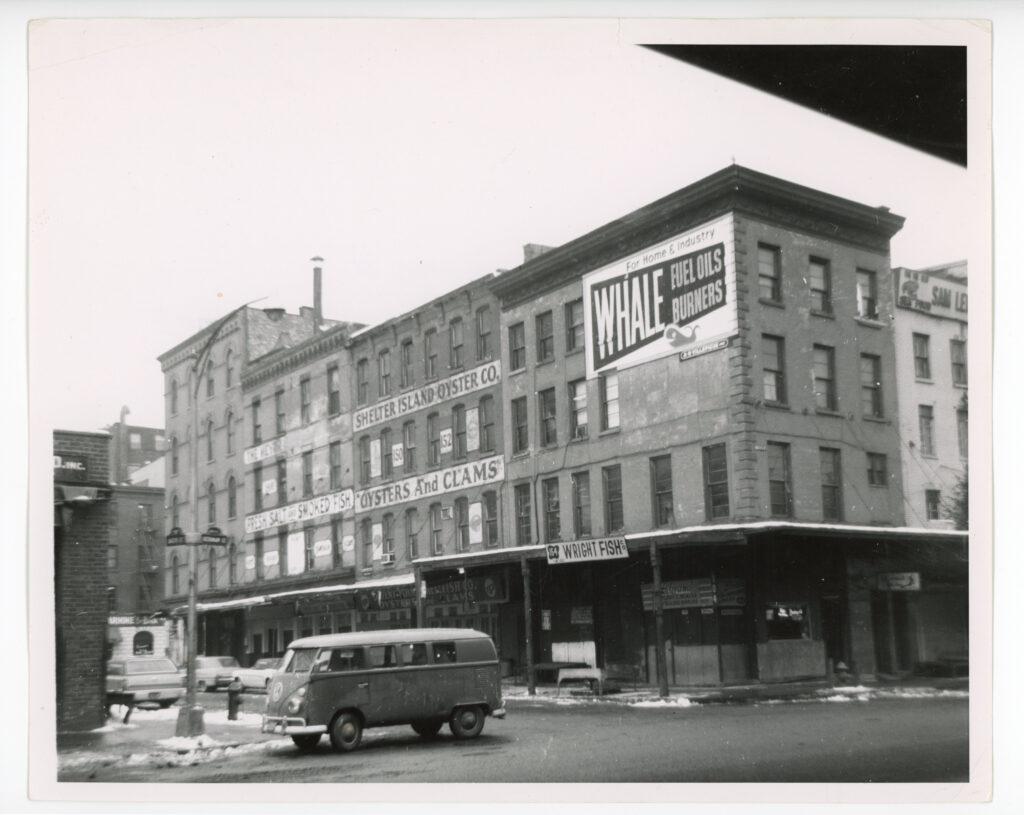
South Street Seaport Museum Archives
The lettering on the lighthouse base draws inspiration from this tradition. During the mid-19th century, designers often mixed serif and sans-serif typefaces, creating dynamic compositions that guided the eye across a building. The result was signage that was both practical and visually striking—designed to be read from a distance in a crowded urban environment.
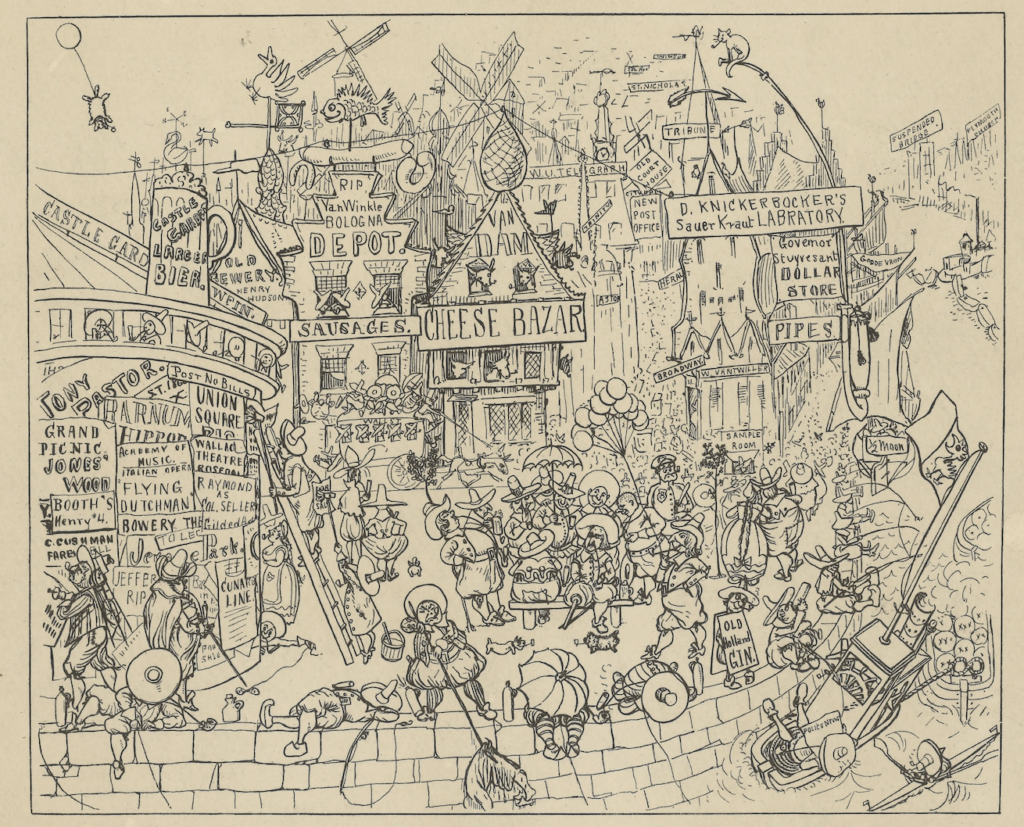
Historical illustrations reinforce this approach, frequently depicting buildings with bold black lettering set against light backgrounds to maximize contrast and visibility.
The lighthouse design adopts the same principle, using distinct bands of color and typography to create a strong graphic presence while honoring the neighborhood’s historic streetscape.
Walter Francis Brown (American, 1853-1929). “New York Under the Dutch (From the Battery)” 1875-1876. Found in Collection 2000.018.0024.A-.B
Designing the lettering for the lighthouse base presented a unique challenge: unlike the flat façades of historic Seaport buildings, the structure is cylindrical and tapers. That meant the typography had to work not from a single viewpoint, but from multiple angles and distances, and remain legible as the structure decreased in width.
The Museum’s designers approached the lettering as a layered experience while also building on the historical intent of the Titanic Memorial Lighthouse as a wayfinding aid. Much like how it originally brought the seamen into the Seamen’s Church Institute, it now brings maritime buffs into the South Street Seaport and Seaport Museum.
With this in mind, the first layer of text—“South Street Seaport Museum”—was intentionally given prominence because it reflects how the neighborhood is commonly known today and serves as a welcoming marker for the district. As a gateway to both the Museum and the historic waterfront, the structure functions much like a beacon, helping orient visitors from a distance.
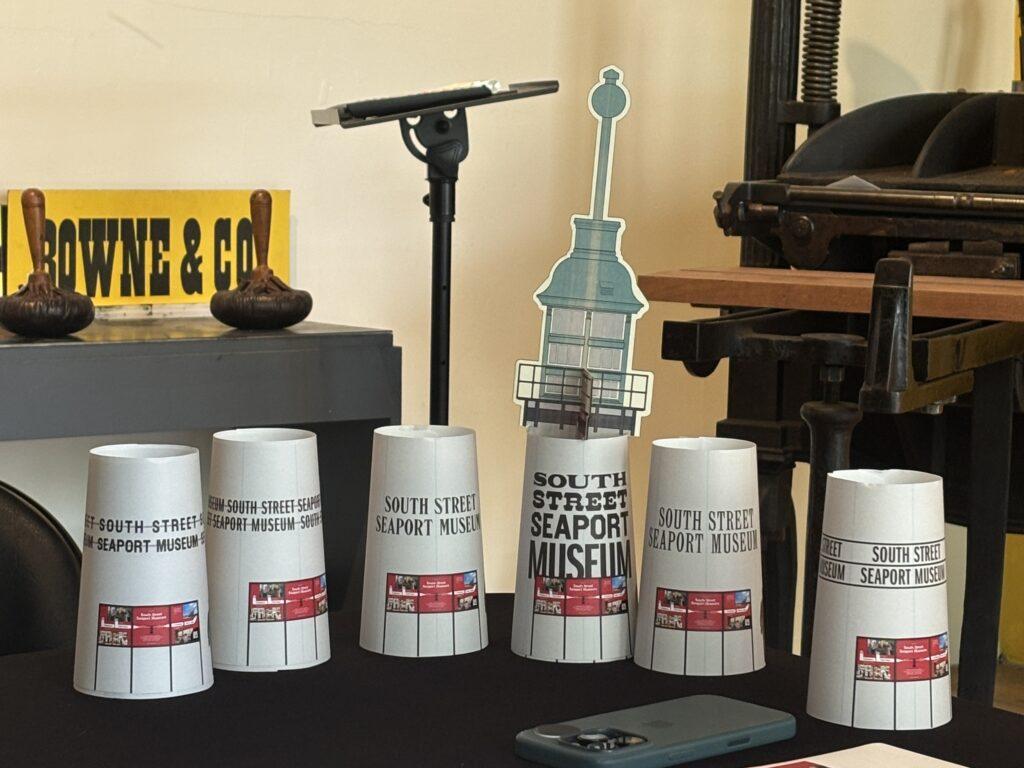
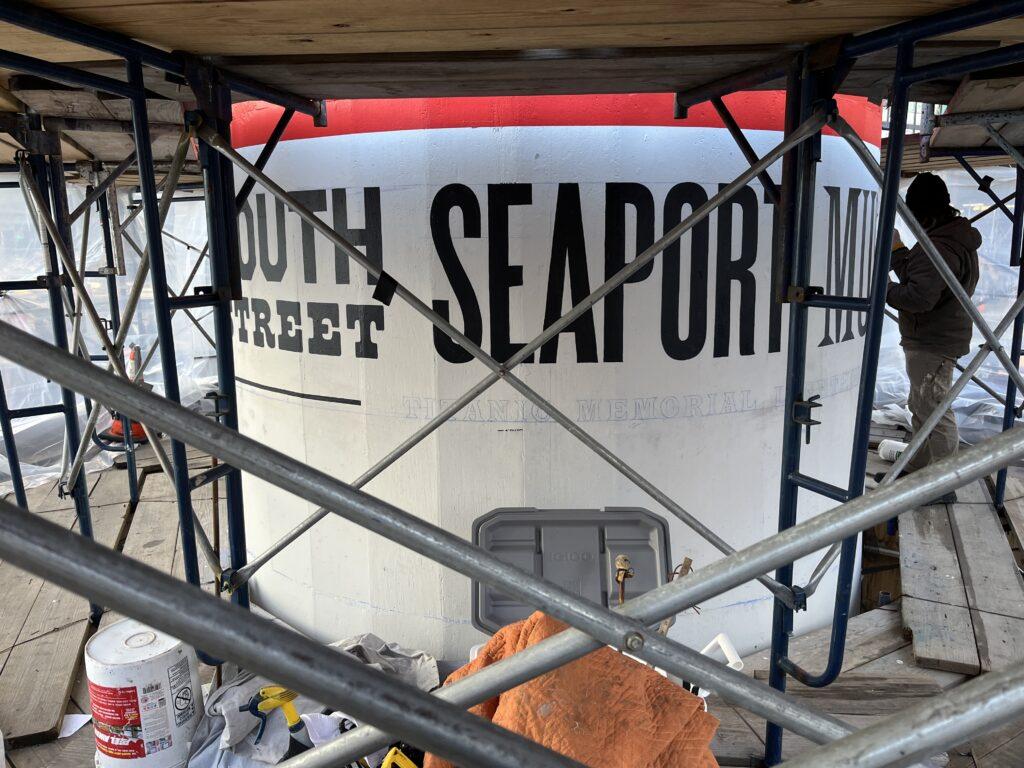
This hierarchy follows a fundamental principle of wayfinding and graphic design: if everything is emphasized, nothing stands out. From across the street, visitors should immediately recognize that they have found the Seaport and the South Street Seaport Museum.
As visitors move closer, additional layers of information become more prominent. The next layer of text identifying the structure as the “Titanic Memorial Lighthouse” provides historical context, helping visitors understand the significance of the object they are approaching.
The design experience continues once visitors arrive at the base. A new historic brass plaque, oriented toward Southampton, England—where Titanic began its voyage—invites visitors to consider the ship’s journey and the lighthouse’s connection to that history. Standing before the plaque places visitors on the same geographic line between the ship’s point of departure and its intended destination, creating a subtle but meaningful connection across time and distance.
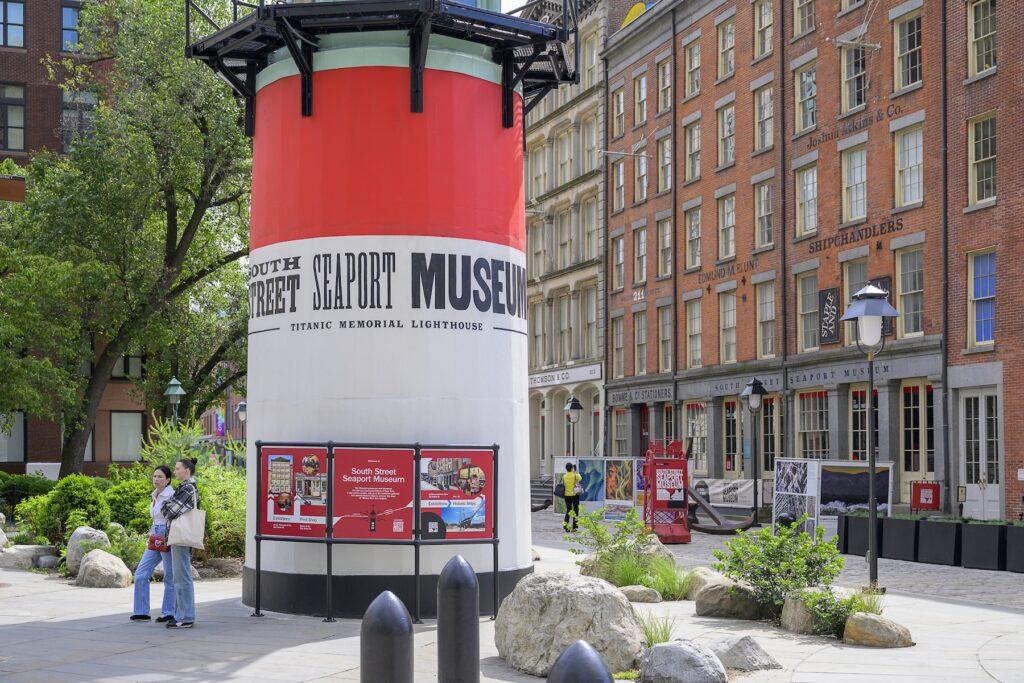
Photo credit Richard Bowditch
More Than a Lighthouse: A History of Reinvention
One of the most surprising facts about the structure is that it was never originally intended to be a lighthouse. Nor was it conceived as a memorial.
When it was installed atop the Seamen’s Church Institute in the early 20th century, its purpose was practical and promotional. A vibrant green light shone across New York Harbor, serving as a beacon that guided sailors toward the Institute and its services. In many ways, the structure functioned as a form of advertising—an unmistakable signal drawing mariners to a place of refuge and assistance.
Its association with the Titanic came later. During the construction of the Institute’s headquarters, the Titanic sank in April 1912. The tragedy transformed public perception of the tower, and the Institute embraced its symbolic connection to the disaster, using the story to help raise funds needed to complete the building. Over time, the structure became widely known as a memorial to those lost at sea, even though that had not been its original purpose.
When the Seamen’s Church Institute building was slated for demolition in 1968, the South Street Seaport Museum recognized the tower’s historical significance and stepped in to preserve it. At the time, however, our young Museum did not have a permanent location for the structure. For seven years it was held on Pier 16, awaiting a new home. Even then, it continued its long tradition of public outreach: photographs from the period show signs encouraging visitors to “Visit the South Street Seaport Museum.”
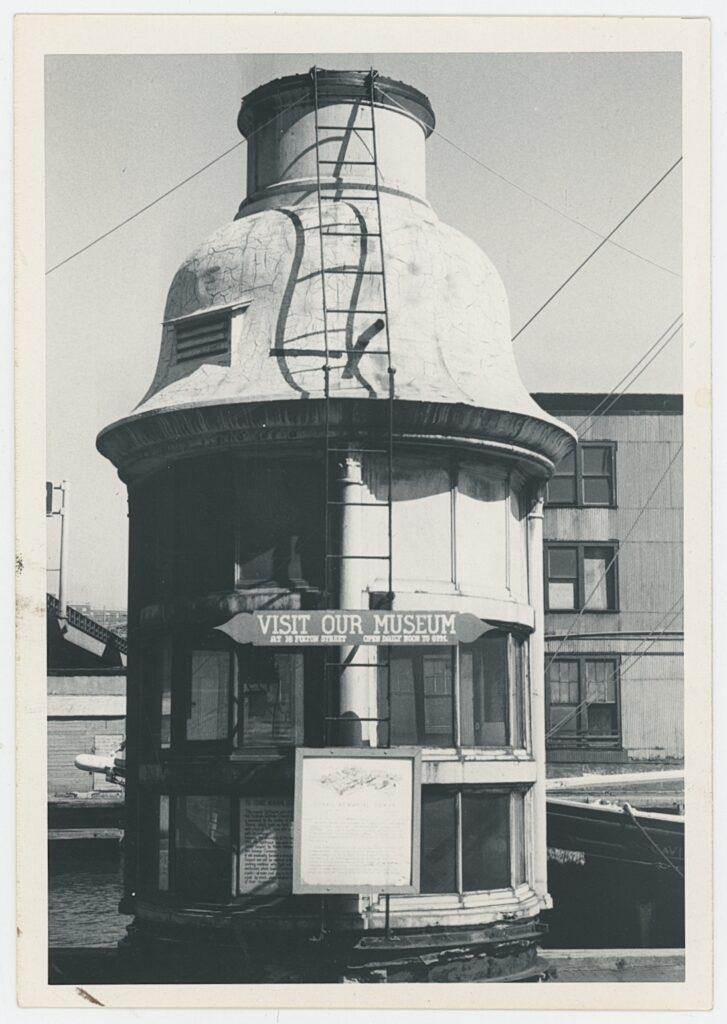
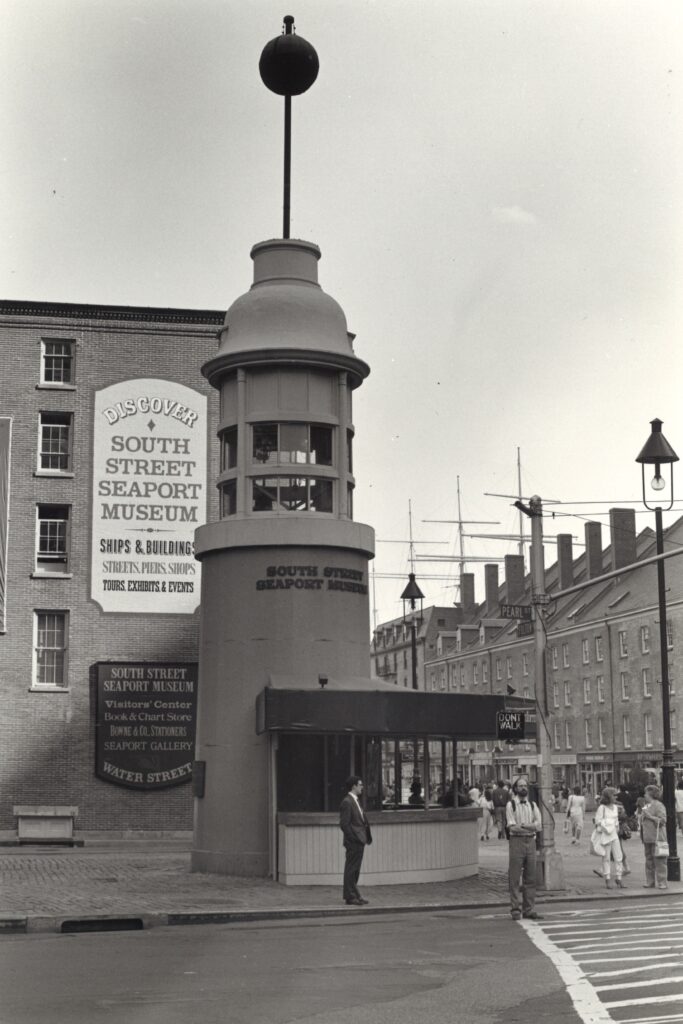
Left: Titanic Memorial Lighthouse at Pier 16, ca. 1970. South Street Seaport Museum Archives
Right: Titanic Memorial Lighthouse, ca. 1985. South Street Seaport Museum Archives
In 1975, thanks to a generous donation from Exxon, the structure was installed on the cast-concrete base it occupies today. From the beginning, that base prominently featured the Museum’s name, and over the years it has displayed event announcements, exhibition promotions, and neighborhood information. For a time, it even served as the Museum’s ticket booth.
This history reveals an often-overlooked aspect of the structure’s identity. While many New Yorkers know it as a lighthouse, its most enduring role has been as a beacon in a broader sense—first attracting sailors to the Seamen’s Church Institute and later welcoming visitors to the South Street Seaport Museum. For more than a century, it has been a landmark designed to draw people in.
Today’s restoration acknowledges both sides of that history. Although the structure was never technically a lighthouse, generations of New Yorkers have come to recognize it as one. The new paint scheme embraces this evolution, drawing inspiration from the bold red, white, and black banding often found on traditional lighthouses while preserving the structure’s long-standing role as a visual landmark and gateway to the Seaport.
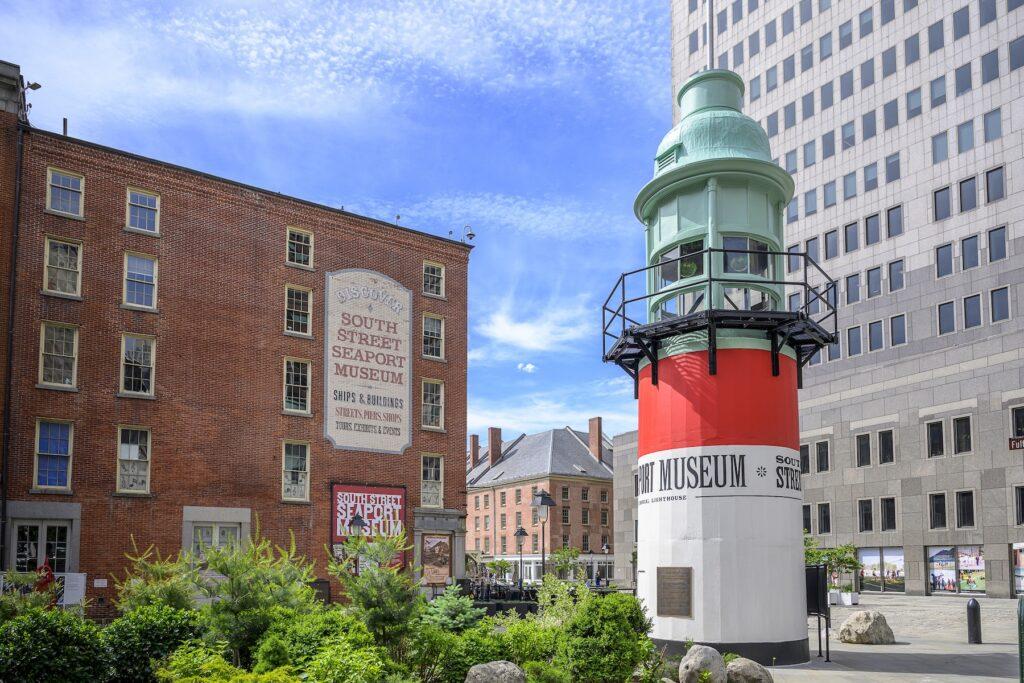
Photo credit Richard Bowditch
The restoration of the Titanic Memorial Lighthouse was never intended to return the structure to a single moment in time. Instead, the project sought to preserve and interpret the many layers of history that have shaped the monument over more than a century—from its origins atop the Seamen’s Church Institute, to its relocation and preservation by the South Street Seaport Museum, to its continuing role as one of the most recognizable landmarks of the Seaport.
As visitors continue to discover the restored lighthouse, we look forward to sharing more stories uncovered during the project. We hope that the next time you walk through the Seaport and look up at the green lantern, you will see not only a familiar landmark, but also the remarkable history, craftsmanship, and research that brought it back to life.
Thanks to all our restoration partners:
Architect: Jan Hird Pokorny Associates, Inc.
Structural Engineer: Gedeon GRC Consulting
Electrical Engineer: Landmark Facilities Group, Inc.
Contractor: PRESERV Building Restoration Management
Funded in part by United States Lighthouse Society
Additional Readings and Resources
The Preservation of Historic Architecture: The US Government Official Guidelines for Preserving Historic Homes. Department of the Interior. Guilford, CT. Lyons Press, 2004.
Historic Building Facades: A Manual for Maintenance and Rehabilitation. New York Landmarks Conservancy. New York. The Preservation Press, John Wiley & Sons, 1997.
Protecting the Past from Natural Disasters. Carl L. Nelson, Joseph P. Riley. Washington, D.C. The Preservation Press, 1991.