

Women in Caricature from the Rare Books Collection
A Collections Chronicles Blog
By Emilie Puja, Archival Collections and Rare Book Intern
March 5, 2026
When you have hundreds of books to catalog, it’s tempting to complete the process as efficiently as possible. However, a large collection of rare books is bound to have hidden gems worth the extra research.
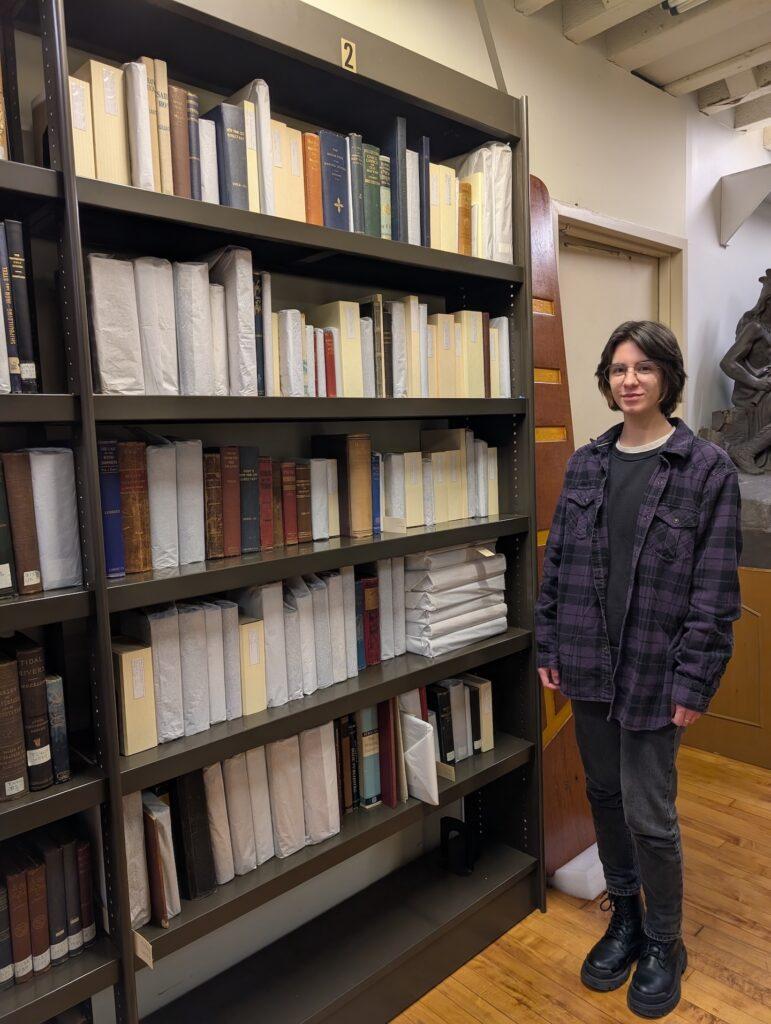
As a Fall 2025 Archival Collections and Rare Books Intern at the Seaport Museum, one of my primary projects was completing a cataloging initiative that began in 2019 for more than 1,700 rare books transferred from the Maritime Reference Library to the archives. Over the course of the internship, I cataloged over 150 rare publications, many of which required additional preservation measures. Books with concerns such as fallen spine covers or red rot could be contained by wrapping them in archival tissue, while books with more structural damage required custom phase boxes.
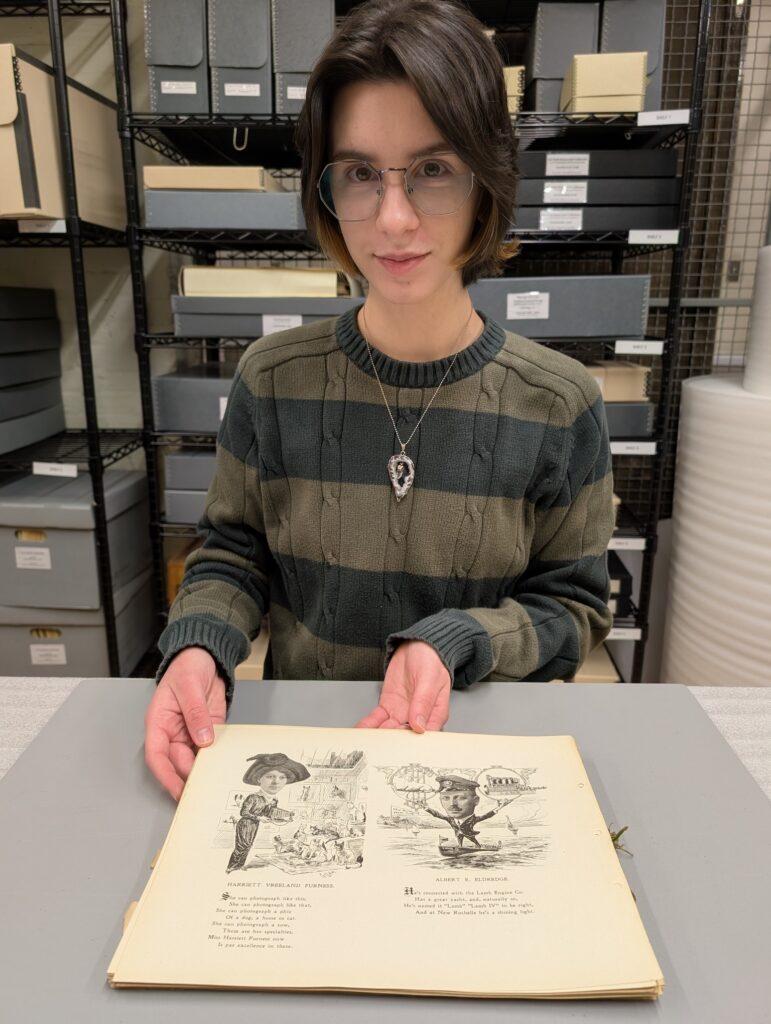
While cataloging the rare books that had been moved from the Seaport Museum’s Maritime Reference Library to the archives, many volumes stood out, but a few were compelling enough to spend time flipping through every page. One book, with no front cover or title page, stood out not only for its condition but also for its striking first page. The page features caricatures of two men, one an accountant and one a dancer, paired with comedic poems about their work. Though the rest of the book is similar, depicting prominent men of New York and their work or hobbies, a careful look reveals caricatures of 14 women.
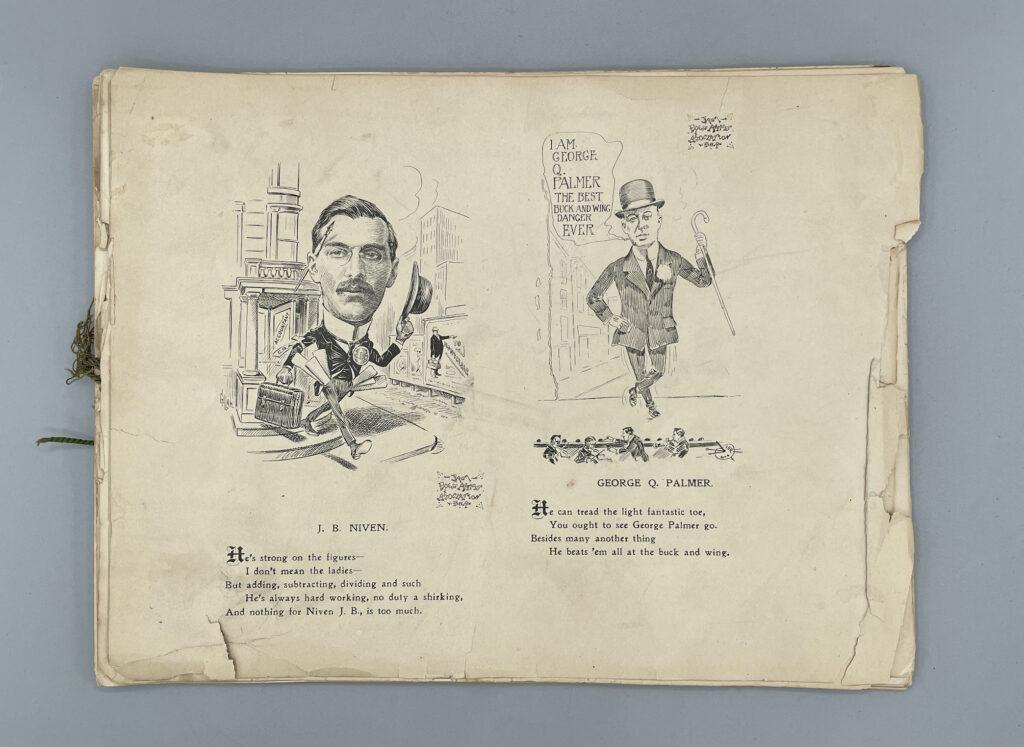
First page of [Caricatures of prominent New Yorkers], ca. 1912. South Street Seaport Museum, Rare Books Collection
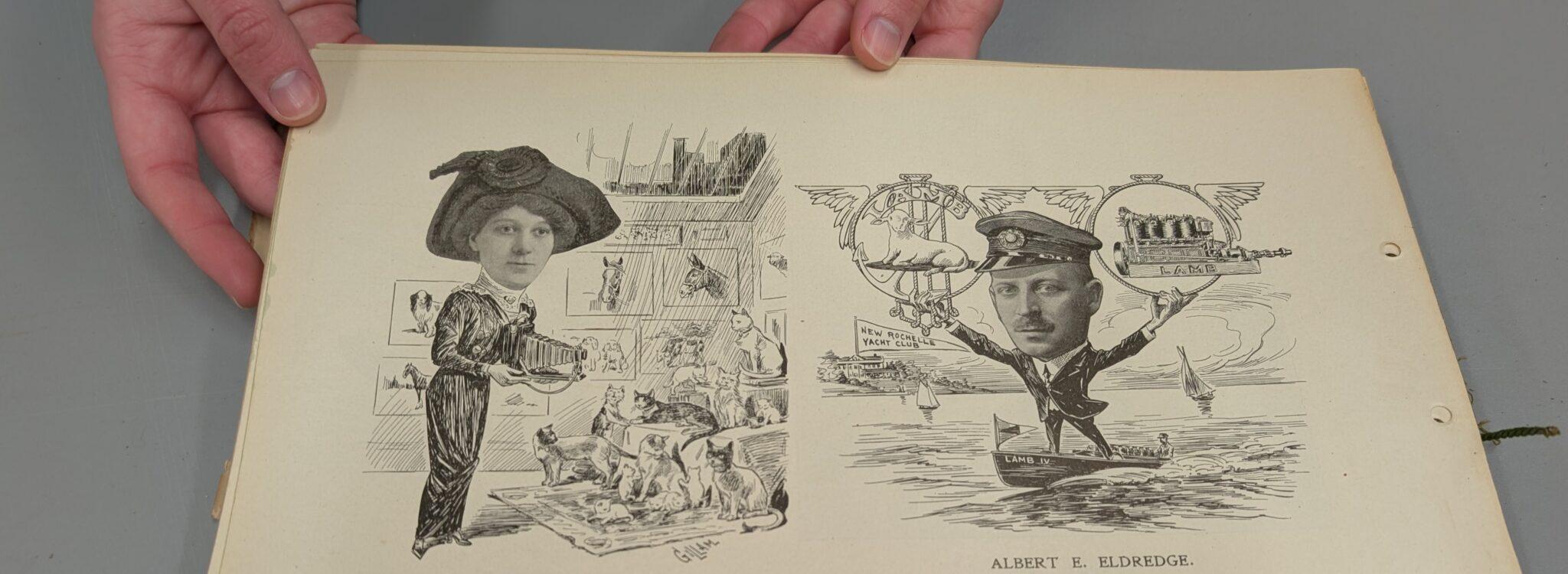
Caricatures are drawings that exaggerate the subject’s features for comedic or satirical effect. Most of the caricatures in this book enlarge the heads of prominent New Yorkers and depict them in a way that exaggerates the work or hobby they are best known for. The caricatures are lithographic prints, but the heads of some men and most of the women appear to use halftone printing[1]Halftone process, in printing, is a technique consisting in breaking up an image into a series of dots so as to reproduce the full tone range of a photograph or tone art work. Breaking up is usually … Continue reading to place a real photo of the women’s heads on illustrated bodies. Cartoonist Victor Gillam (ca. 1858–1920), one of the artists featured in this book, used this technique.
Given that caricatures often mock the subject, it is notable that every woman in this book is represented in a respectful manner that praises her skills, disposition, and overall success.
The Book Itself
We could not identify this exact book, but there are similar books compiling caricatures of individuals made by multiple artists. For example, the 1914 book Club Men of Rochester in Caricature features drawings by Jack Sears (1875–1969) and Associate Artists.
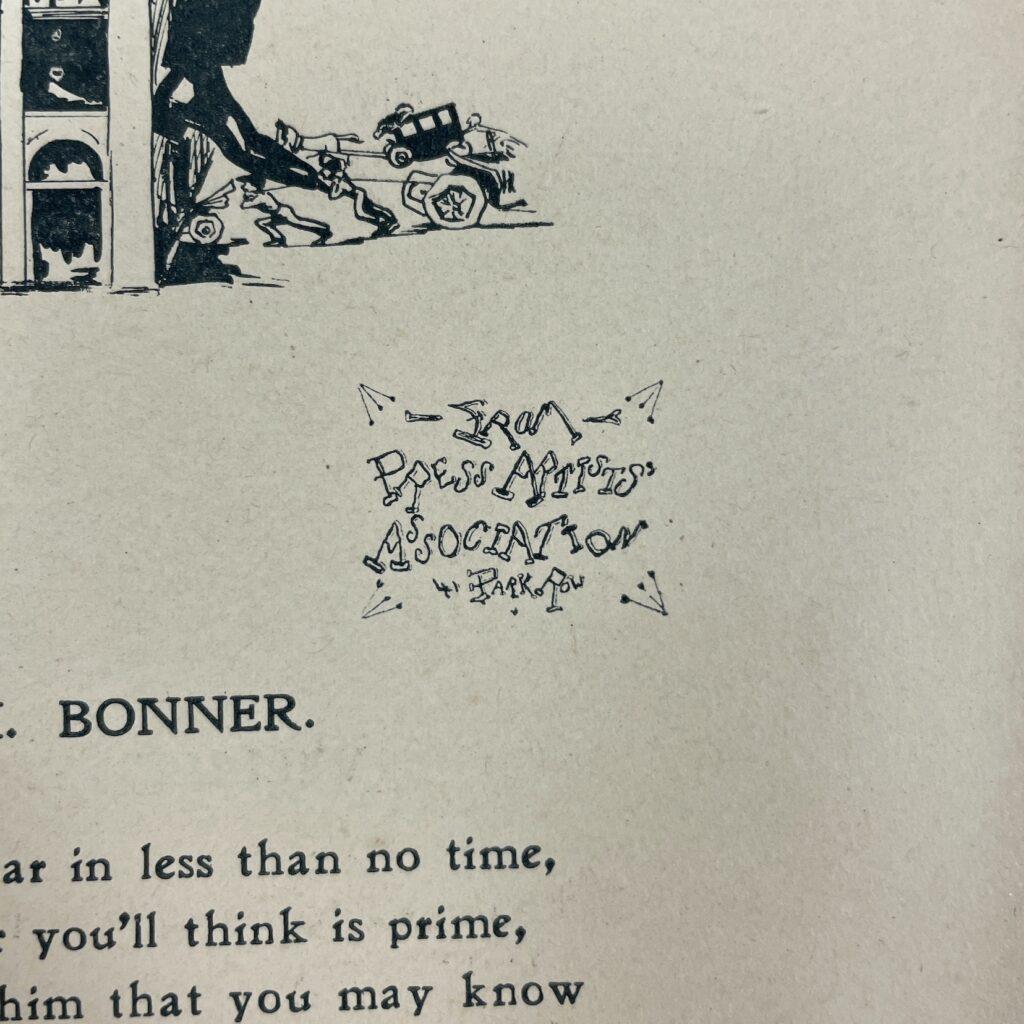
Similarly, this book features many caricatures by artists from a group called the Press Artists’ Association, as indicated by a watermark that reads “Press Artists’ Association 41 Park Row.”
Though it has been difficult to identify a Press Artists’ Association active in early 20th century New York, 41 Park Row was previously the headquarters of The New York Times.
Given the book’s haphazard string binding, repeat pages, and lack of page numbers, it very possibly was not a widely published creation.
It may have been a custom print job by The New York Times or Roycrofters (the publisher of Club Men of Rochester in Caricature), and records of such an item would be difficult to find compared to items for sale by these publishers.
[Caricatures of prominent New Yorkers], ca. 1912. South Street Seaport Museum, Rare Books Collection
Though this book is likely in the Seaport Museum’s collections for its occasional references to fishmongers and yacht clubs, I decided to explore the women in it for this Women’s History Month. Among these figures, Ida Madeleine Powell Black (1871–1952), Harriett Vreeland Furness (1875–1955), Clarice Manning (active 1911–1912), Mary Winthrop Turner (b. 1886, active 1902–1912), and Mme. Cerlian (born Helene Dimpre in 1872, active 1911–1940) are arguably a few of the most interesting, as New York women respected for finding success in their passions.
Ida Madeleine Powell Black (Mrs. Elmer Black) (1871–1952)
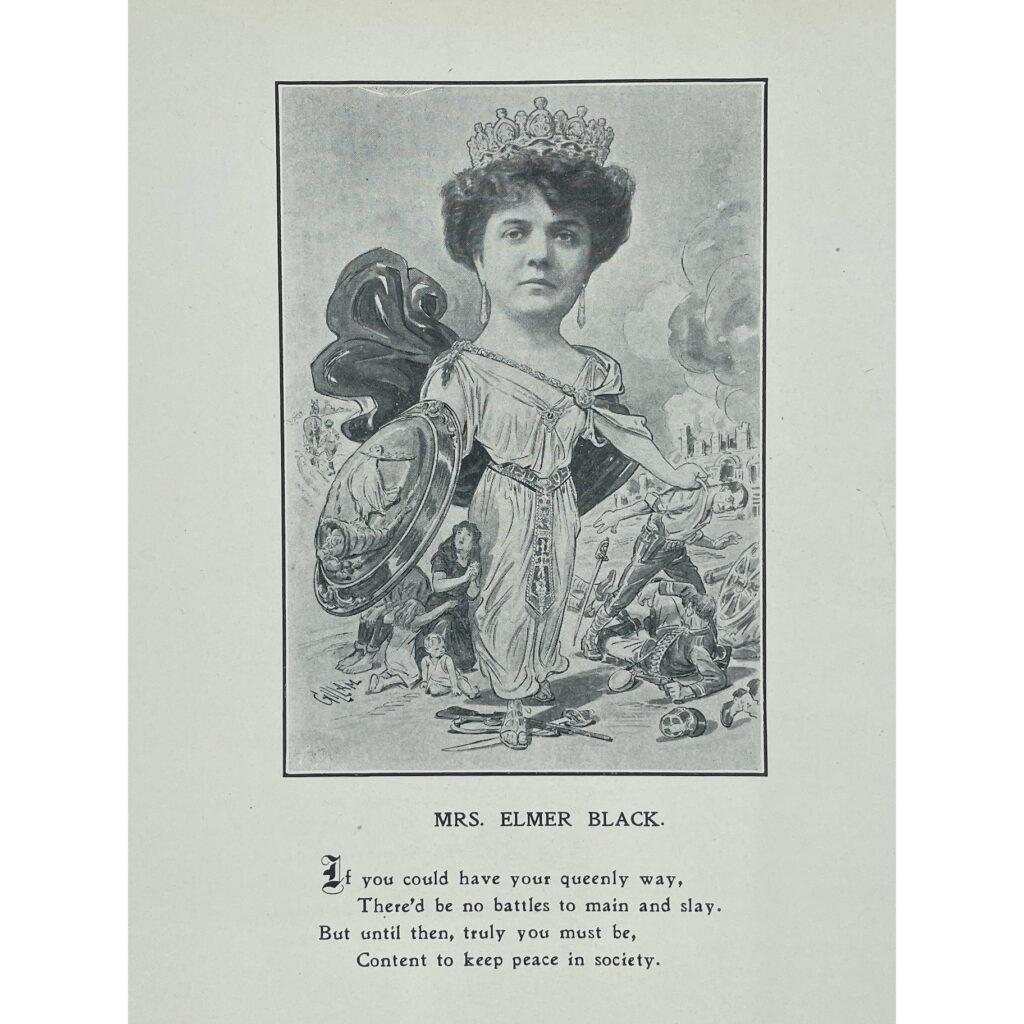
The caricature of “Mrs. Elmer Black”—Ida Madeleine Powell Black—depicts her as a queen protecting women and children amid battle, pulling the fighting men away and stepping on their weapons. Accompanying the caricature is a poem that suggests Black “keeps the peace in society.”
These elements allude to her work as Chairman of the American Peace and Arbitration League[2]The American Peace and Arbitration League flourish 1909–1914. “American Peace and Arbitration League Collected Records” Philadelphia Area Archives and her involvement in the New York Peace Society[3]The New York Peace Society was active from 1815 until 1940, when the Society merged with the World Alliance for International Friendship Through Religion. “New York Peace Society Records” … Continue reading.
Black authored two books, one being A Terminal Market System (1912), which argues for New York to adopt a terminal market system by citing the significantly higher profits of “modern market methods” in European countries and other American cities. Her book Civilize the Nations (1911) is in favor of international law and arbitration, arguing that the United States should lead an international peace movement.
Several headlines from The New York Times published in the early 20th century feature Black, reporting on events such as her producing a play, her sudden second marriage, and her exoneration in the case of a check cashed with insufficient funds. An article from 1911 reports her return to New York on the RMS Caronia and her activities as Chairman of the American Peace and Arbitration League. Black met Queen Mary of England and lauded her “as a woman of wonderful force of character, who would be a great help to her husband, the King, in his governmental labors,” according to reporters.
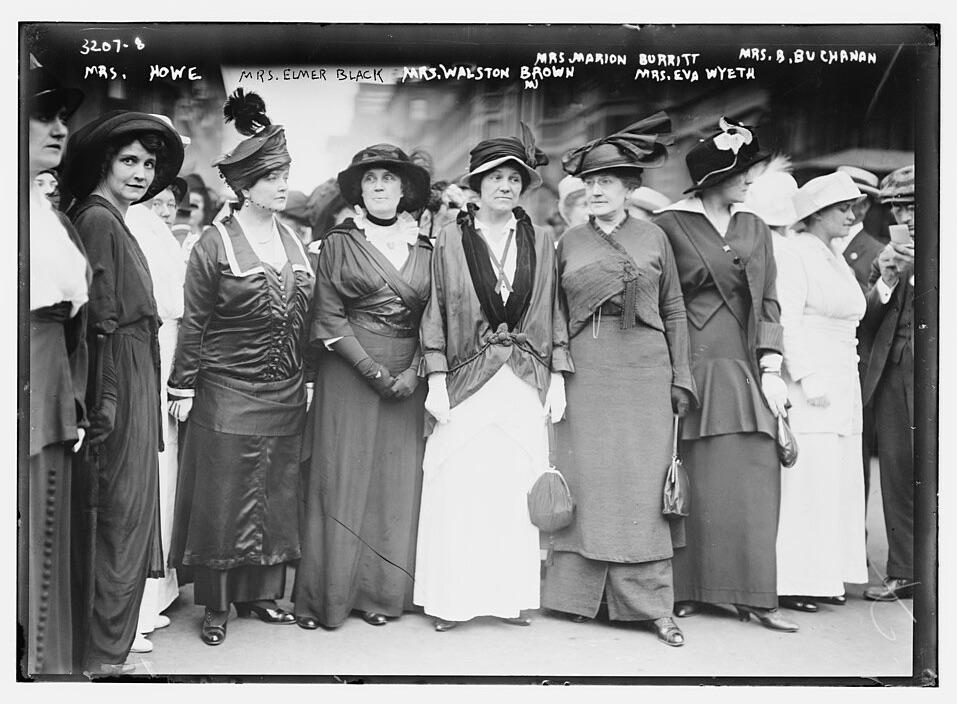
“Mrs. Howe, Mrs. Elmer Black, Mrs. Walston Brown, Mrs. Marion Burritt Mrs. B. Buchannan, Mrs. Eva Wyeth” August 29, 1914. Glass plate negative. Bain News Service photograph collection. Library of Congress Prints and Photographs Division Washington, D.C. https://www.loc.gov/pictures/item/2014697172/
Notably, only one 1916 The New York Times article uses Madeleine Powell Black’s own name. “Mrs. Elmer Black” was her name in headlines, as an author, and as Chairman of the League, but “Mrs. Madeleine Powell Black” only appears in the article in which she is a defendant. After her husband passed, she then remarried becoming Ida Madeleine Powell Black Elliot.
Harriett Vreeland Furness (1875–1955)
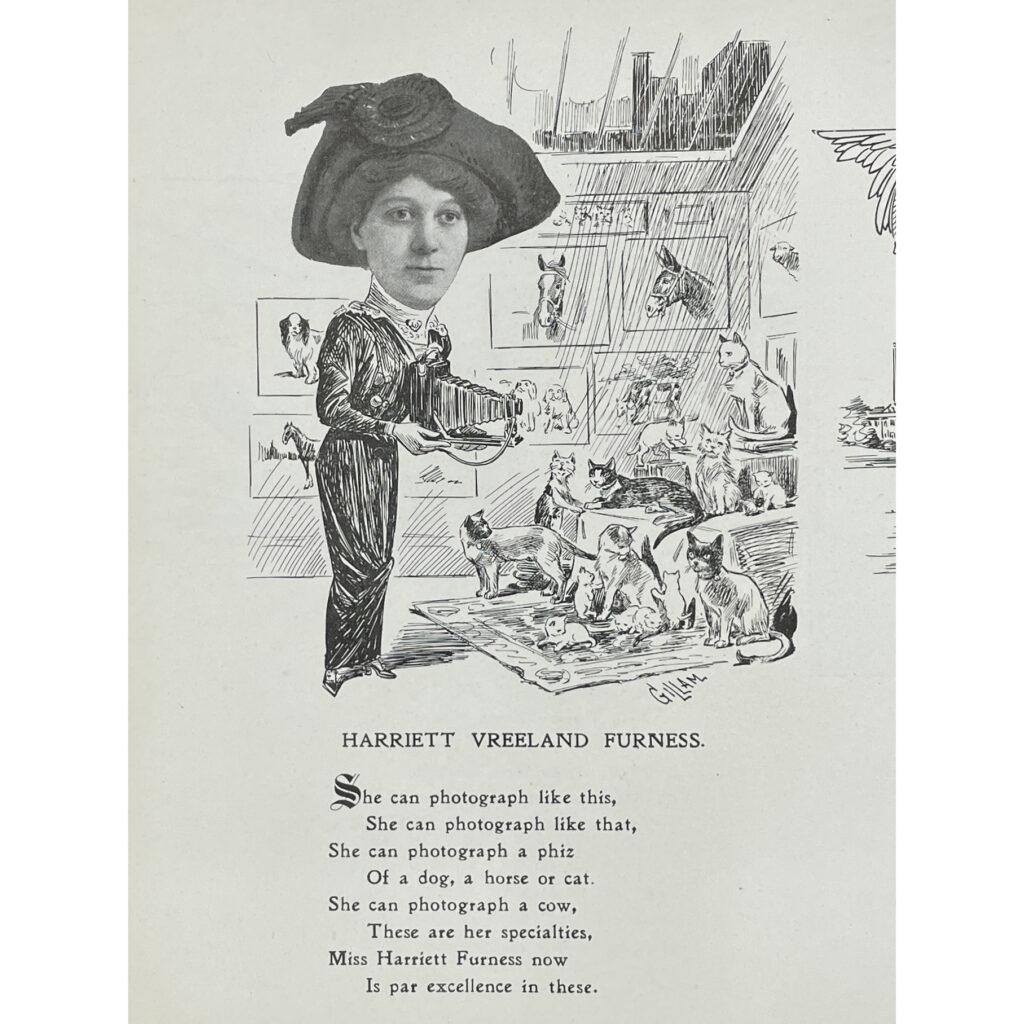
Harriett Vreeland Furness—born Harriet Elizabeth Vreeland—was a painter and photographer of animals, particularly cats. She was active in New York City ca. 1900–1920. This caricature praises the “excellence” of her work. Artwork and photographs found online suggest that Persian cats were a common subject of her work. She also bred and sold Persian cats, meaning that some of these furry subjects might have once been her own kittens.
Her services were advertised in magazines, offering watercolor or oil portraits, including miniature paintings on ivory or china. One of her paintings, a miniature watercolor portrait on ivory of a Persian cat, measures a mere 1-½ by 2 inches. In 1923, her work was displayed at the 15th annual art exhibition at the Stockbridge Casino in Stockbridge, Massachusetts.
Furness expressed her love of cats through not only art but also writing. A book compiling quotations about cats, Alexander and Some Other Cats (1929), includes some thoughts from Furness on the “peculiarities of animals as models.” She explains that cats’ similarities to humans, particularly their unique personalities and intelligence, are “a constant revelation and inspiration.”
Clarice Manning (active 1911–1912)
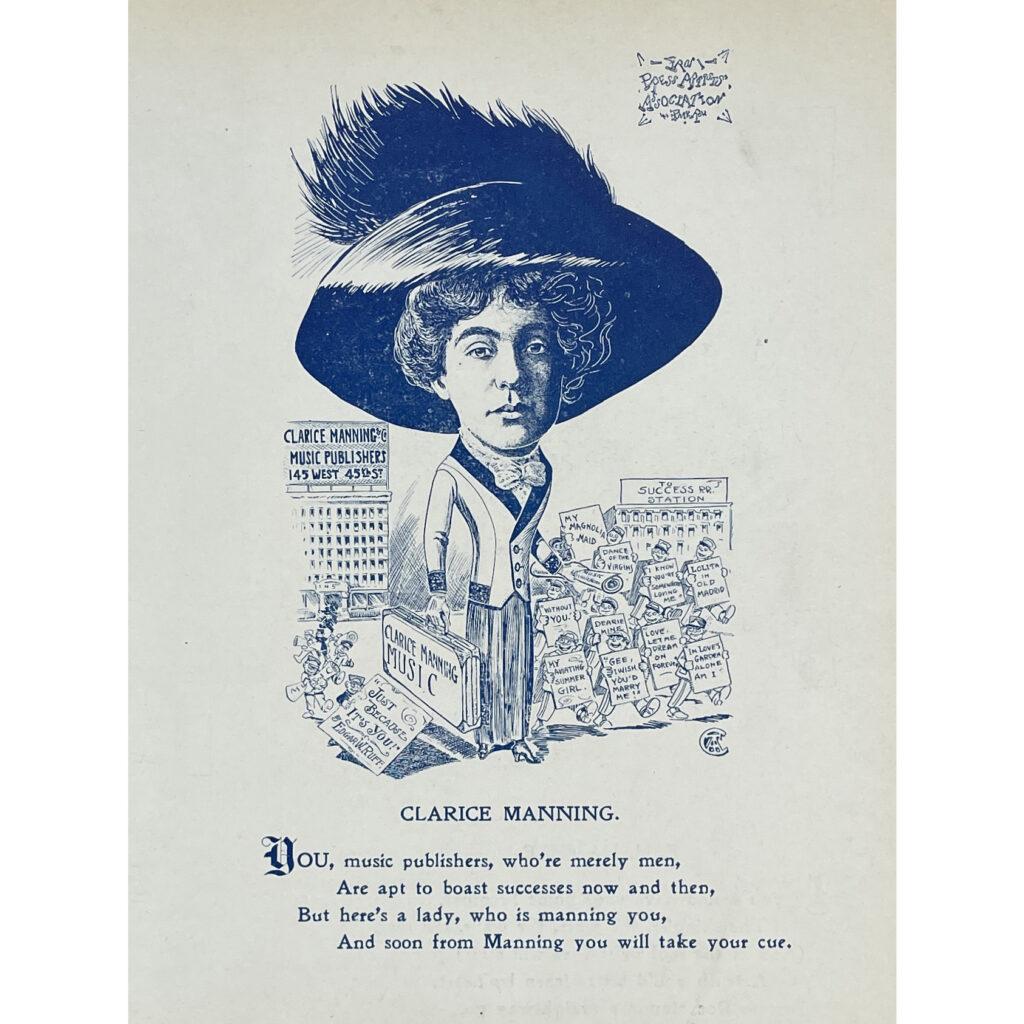
Clarice Manning was a composer and lyricist for her own music publishing company Clarice Manning & Co. in the early 20th century. According to a 1912 issue of The Billboard, Manning controlled “the best selling small catalogue on the market” at the time.
The poem below her caricature uses wordplay on her last name to emphasize her success above men in the music publishing industry, calling her “a lady, who is manning… the music publishers, who’re merely men.”
Several of Manning’s songs, including sheet music and lyrics, can be found online, such as the “My Magnolia Maid” (1911), “Gee! I Wish You’d Marry Me” (1911), “Lolita In Old Madrid” (1911), “I Know You’re Somewhere Loving Me” (1912), and “My Aviating Summer Girl” (1911). The cover for Manning’s 1911 song “Awake Beloved For Our Wedding Morn” features a portrait of her.
Mary Winthrop Turner (b. 1886, active 1902–1912)
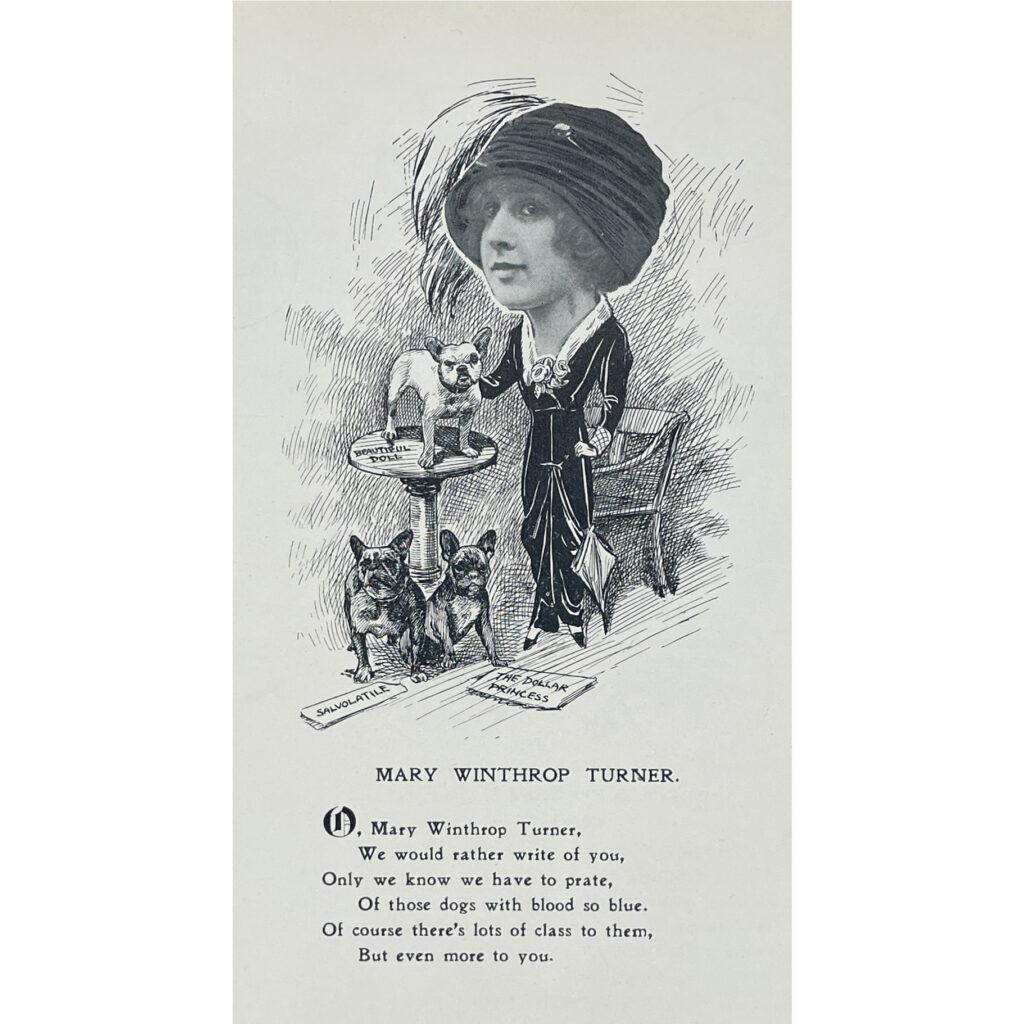
Mary Winthrop Turner has been described as an influential dog breeder, handler, and judge, particularly for the French Bulldog breed in America. The poem below this caricature recognizes that her dogs so often receive praise, which Turner deserves as well.
An article from Crowd Pleazer Frenchies[4]“Mary, Mary, (Beautifully) Contrary: The Legend Behind the Breed” Crowd Pleazer Frenchies, 2023 provides a detailed overview of Turner’s influence and success, detailing her life from a runaway orphan, to a “Brooklyn heiress,” to one of the most successful French Bulldog breeders of her time.
Her success afforded her many opportunities, such as issuing public challenges to rivals, becoming a judge of French Bulldogs, and editing the popular magazine The French Bulldog. After Mary’s husband passed away, his ex-wife sued her, leading to the public revelation that she was not an heiress but an orphan. She lost her country estate, became the subject of gossip columns, and what happened to her thereafter is unknown.
Mme. Cerlian (born Helene Dimpre in 1872, active 1911–1940)
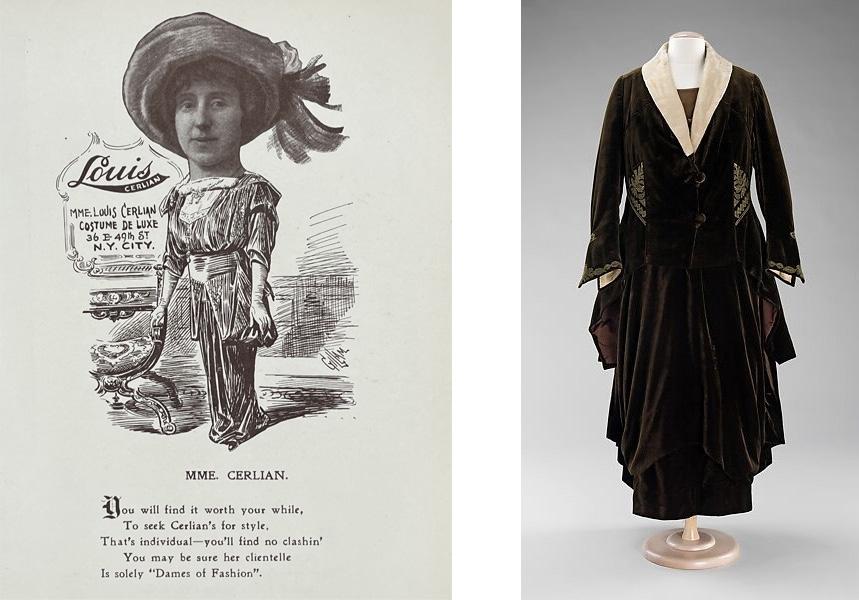
Right: An evening ensemble designed by Madame Louis Cerlian, from the Metropolitan Museum of Art.
Madame Louis Cerlian was a costumer in the early 20th century, whose designs were sold by Louis Cerlian New York. Though the business bore her husband’s name, she was a designer well-known for her fashion sense, as her caricature notes “her clientele is solely ‘Dames of Fashion.’” One of her designs, an evening ensemble dated to 1914–1918, can be found in the Brooklyn Museum Costume Collection at The Metropolitan Museum of Art. The Met describes the ensemble as “a rare example from a transitional period in women’s fashion.” The Met also has multiple pieces donated by Mme. Cerlian, including women’s suits and eveningwear.
Future Research of Rare Books
While the project is technically complete, the research potential within the Rare Books Collection is only just beginning to unfold. The book of caricatures is not the only volume that stands out for its portrayal of women. Other titles of note that I cataloged this Fall include Samantha at the World’s Fair (1893) by Marietta Holley and What Can a Woman Do (1881) by M. L. Rayne.
Holley’s satirical novel explores themes of progress, social change, and the complexities of family life, while Rayne’s work examines late 19th century occupations available to women across business, the arts, medicine, and other fields. Periodicals aimed at women, such as Godey’s Lady’s Book, likewise offer valuable insight into the fashions, cultural expectations, and evolving identities of American women in the mid to late 19th century.
Cataloging hundreds of rare books can be repetitive and time-consuming, but knowing that each one is carefully documented and indexed by subject makes all the effort worthwhile. I’m really proud to have helped make this work happen—creating a foundation that will support interesting research and discoveries for years to come.
Additional Readings and Resources
“Caricature”, Tate Gallery.
“Rare Books: What Makes Them Special & How to Care for Them” by Rose Briskman and Lluis Tembleque Teres, London Museum, March 5, 2024.
“Women in American Politics in the Twentieth Century” by Sara Evans, The Gilder Lehrman Institute of American History, 2006.
References
| ↑1 | Halftone process, in printing, is a technique consisting in breaking up an image into a series of dots so as to reproduce the full tone range of a photograph or tone art work. Breaking up is usually done by a screen inserted over the plate being exposed. The screens are made with a varying number of lines per inch, depending on the application; for newspapers, the range is 50 to 85, and for magazines, 100 to 120. The highest quality reproduction requires 120 to 150 lines per inch. Halftone process, Britannica, https://www.britannica.com/technology/halftone-process |
|---|---|
| ↑2 | The American Peace and Arbitration League flourish 1909–1914. “American Peace and Arbitration League Collected Records” Philadelphia Area Archives |
| ↑3 | The New York Peace Society was active from 1815 until 1940, when the Society merged with the World Alliance for International Friendship Through Religion. “New York Peace Society Records” TriCollege Libraries |
| ↑4 | “Mary, Mary, (Beautifully) Contrary: The Legend Behind the Breed” Crowd Pleazer Frenchies, 2023 |