
Recent Acquisitions for the Archival Collections
A Collections Chronicles Blog
By Elena Abou Mrad, Archives and Special Collections Specialist
September 3, 2026
As most people guess, the job of the archivist is dealing with old stuff. And they’d be right. The archival materials I work with on a daily basis can come from a long time ago as well as from more recent years, but they are far from being stuck in the past. For an archivist, every document is a witness of a moment in the past, from a specific point of view in space and time. And the beauty of working in a Museum is that, with each new acquisition, we get to add more stories.
The new entries to the archives start a conversation with the existing collections, enriching and amplifying their meaning. This is the case for four recent additions to our archives and special collections, each creating a connection between the people and stories from the past and the present.
China Trade Connections
This new acquisition has a strong connection with the Seaport Museum, and to be specific, with the building I am currently sitting in while writing this blog post. This masonry, cast-iron, and timber-framed building, located at 167–171 John Street, was was constructed in 1850 for the A.A. Low & Brothers and named after the founder of the firm, Abiel Abbot Low (1811–1893). A.A. Low & Brother was the most successful firm in the 19th century trade between New York and China, in what is known as the China Trade.
One of their descendants, Elizabeth “Liz” Low, reached out to the Museum earlier this year, and donated 11 photographs and three booklets connected with business of A.A. Low & Brothers. This year’s archival donation follows up another generous gift by her father, Clifford Orne Low, in 2025: an 1850 ship model of N. B. Palmer, one of the firm’s many clipper ships[1]Learn more about N. B. Palmer (and her ship model!) in the Collections Chronicles Blog “Deepening the Story”: https://southstreetseaportmuseum.org/deepening-the-story/.
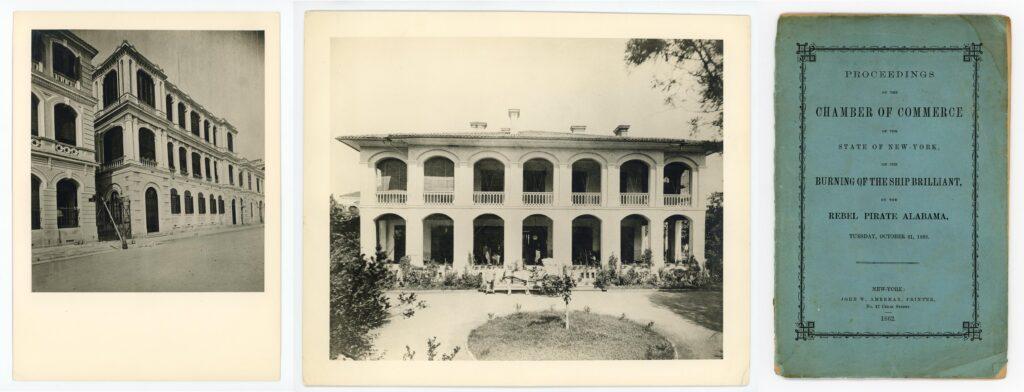
Left Left to right:
[Street view of the Low offices in the Dent & Co. building in Hong Kong], ca. 1868. 2026.003.0008
[Low brothers and a man with a carriage in front of the Low House in Shanghai], n.d. (mid to late 19th century). 2026.003.0011
John W. Amerman, printer. “Proceedings of the Chamber of Commerce of the State of New York on the Burning of the Ship Brilliant, by the Rebel Pirate Alabama”. 1862. 2026.003.0012
Together with the research notes compiled by Low and her family, these archival materials enrich our existing collections, contributing to our understanding of the A.A. Low & Brother firm and the China Trade at large. One detail I hadn’t thought about much is that this was an international firm, with headquarters both in New York and China. Can you imagine the logistics of it, in an era without the internet, or even the telephone? A.A. Low & Brothers was an established firm abroad, as is demonstrated by the photographs of the Low House in Shanghai, taken from nearly every angle and often with the brothers posing in front of it. The house was such a feature of Shanghai that it was even the subject of a watercolor on paper titled “The Low House, Shanghai, circa 1865-1870″ attributed to Chinese artist Chow Kwa (active 1850–1885)[2]”The low house, Shanghai, ca. 1865–1870”, Artnet, https://www.artnet.com/artists/chowkwa/the-low-house-shanghai-o8p5DL-gkzyJAlch_bwtQ2.
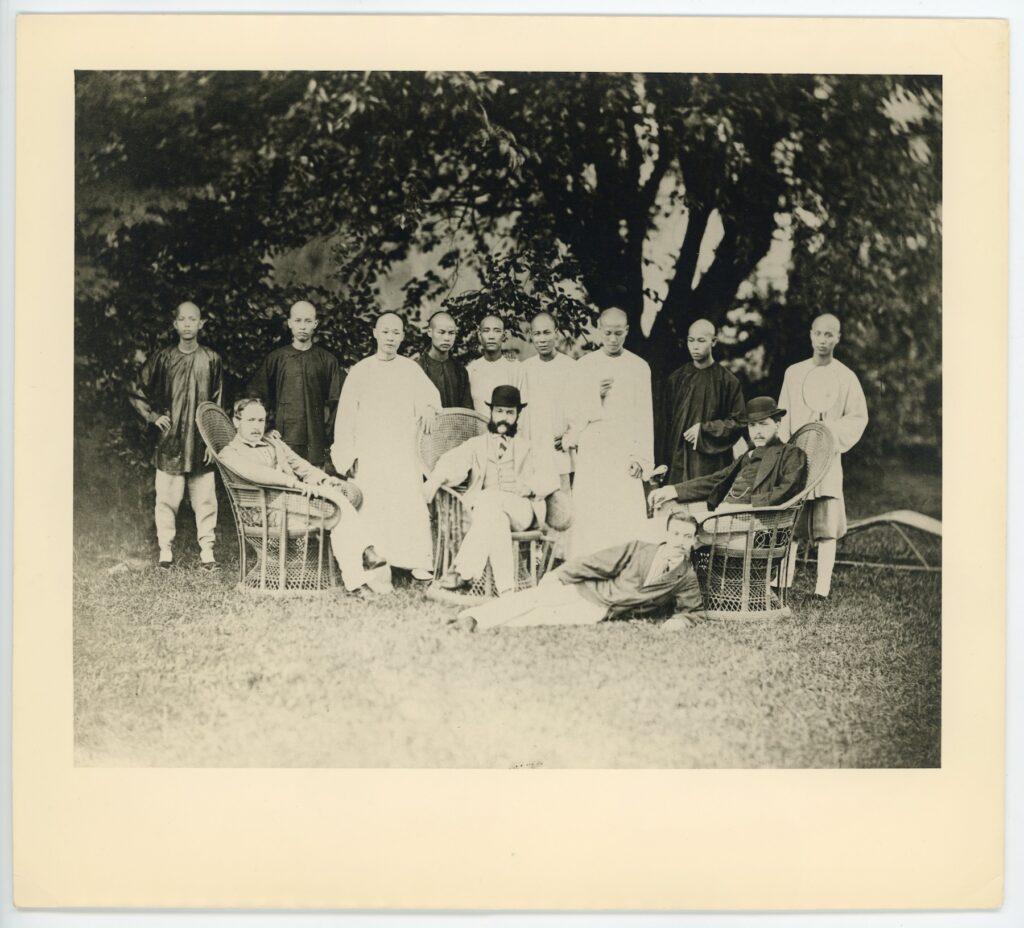
Left: [Low brothers and other men posing for a group picture in China], n.d. (original 1860s-1870). 2026.003.0001
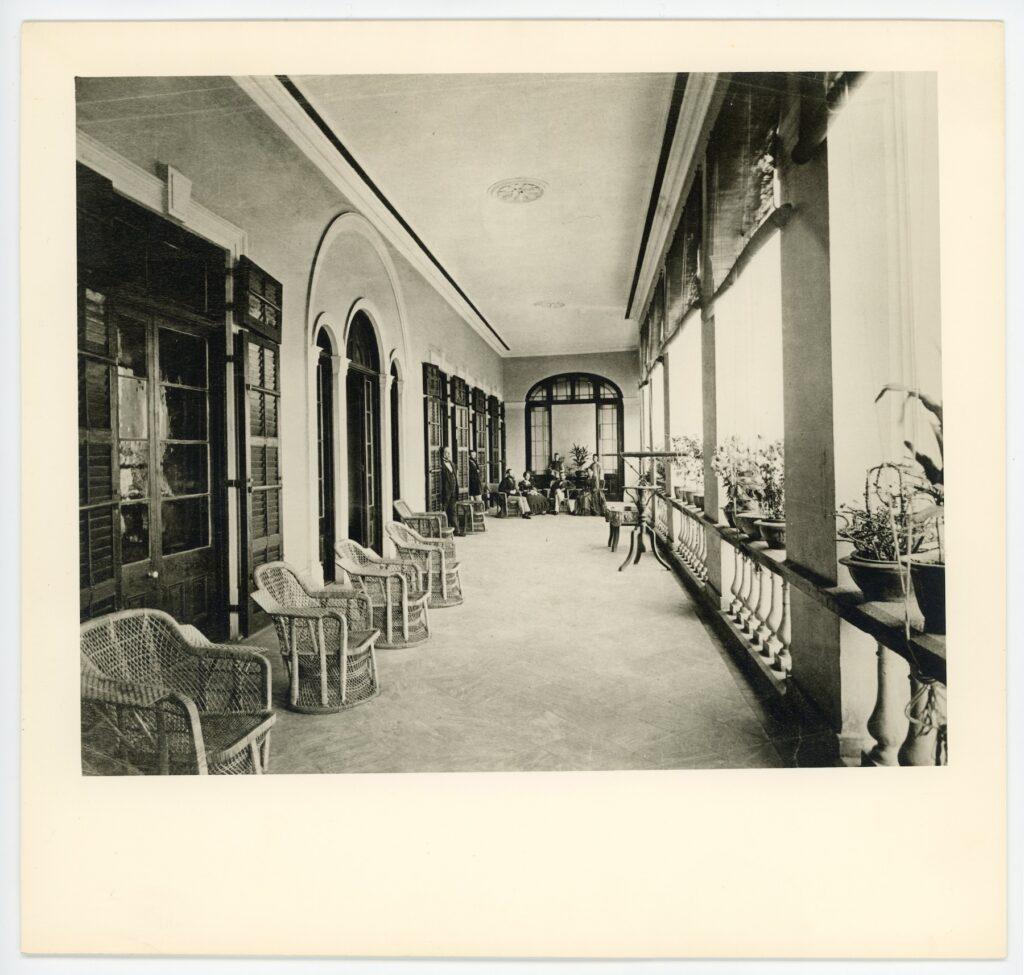
Right: [Low family on the veranda of the Dent & Co. building in Hong Kong], 1868. 2026.003.0006
A.A. Low & Brother also had offices in Hong Kong, inside the Dent & Co. Building, located on the prestigious waterfront promenade of the Praya Central. Unfortunately, the building doesn’t exist anymore, lost to today’s sprawling metropolis—but we’ll always know what it looked like, thanks to these images. The Low brothers can be seen proudly posing with their wives on the terrace of their office building, of which we can also see the exterior and the hallway. Like any powerful photograph, these images from the past left me with more questions than answers. Why would these people pose for a photograph, but put themselves in the very background? And who were all of the Asian men in the images? Are they family friends, employees, or personal staff? These archival materials sit at the intersection of international trade, colonialism, and orientalism.
A Clipper Ship Captain
Back in March, Robert Eskind kindly gifted the Museum archival materials related to Captain Samuel Samuels (1823–1908), who lived right here in New York City and was the commander of clipper ship Dreadnought.
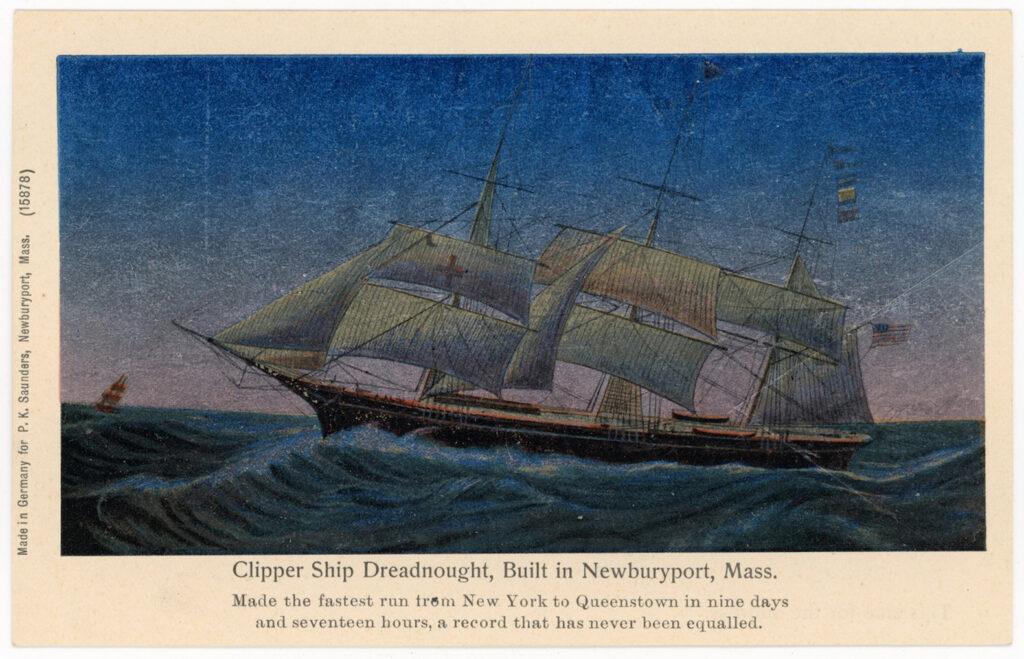
Reichener Bros, publishers. “Clipper ship Dreadnought, built in Newburyport, Mass.”, ca. 1850s. 2026.004.0016
As this postcard boasts, Dreadnought was the fastest clipper ship of her time, celebrated for her passage from New York to Cork (then Queenstown) in only 9 days and 17 hours. She was a large sailing packet of about 1,400 tons and roughly 200 feet long, built specifically for captain Samuels. Between 1853 and 1864, Dreadnought made 31 roundtrips between New York and Liverpool, carrying cargo and passengers—mostly immigrants headed to the United States. This is the first connection to our existing collections: another example of clipper ship history, especially in the perspective of immigration through the Port of New York.
Among the donated materials, the photographs really shine: cabinet cards, cartes de visite, glass natives, and a hand-painted opaltype contribute to the Museum’s collection of holdings related to the history of photography. We also received the copper plate for Captain Samuels’s calling card, which represents a notable piece of printing history—another important focus of the Museum and our letterpress printing shop, Bowne & Co.!
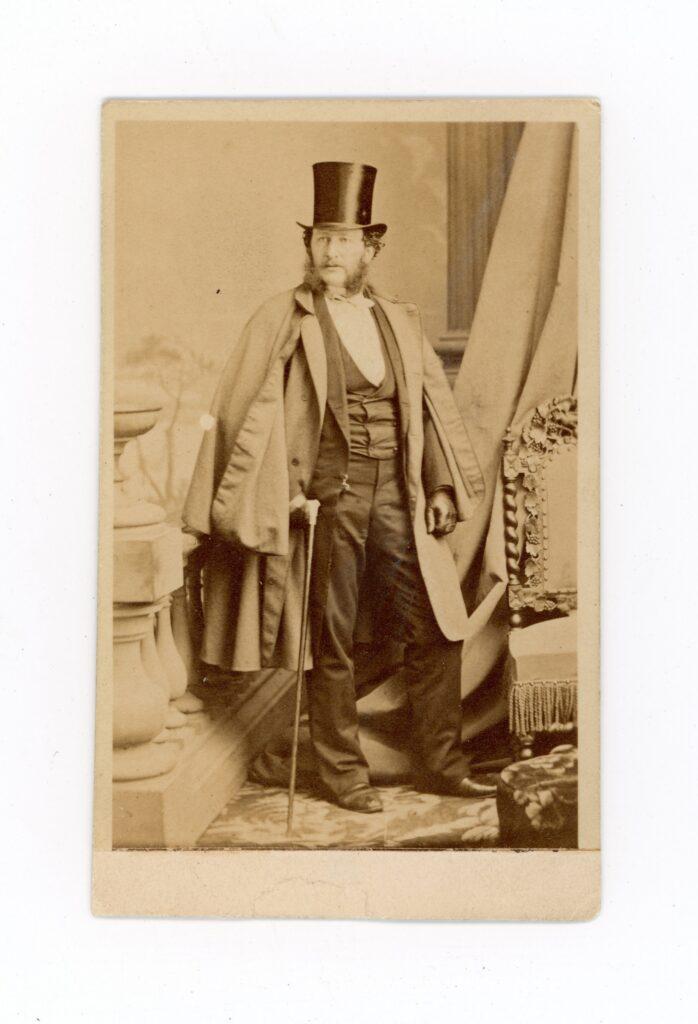
Left: Charles D. Fredricks & Co., photography studio. “Capt. Samuel”, ca. 1870s. 2026.004.0014
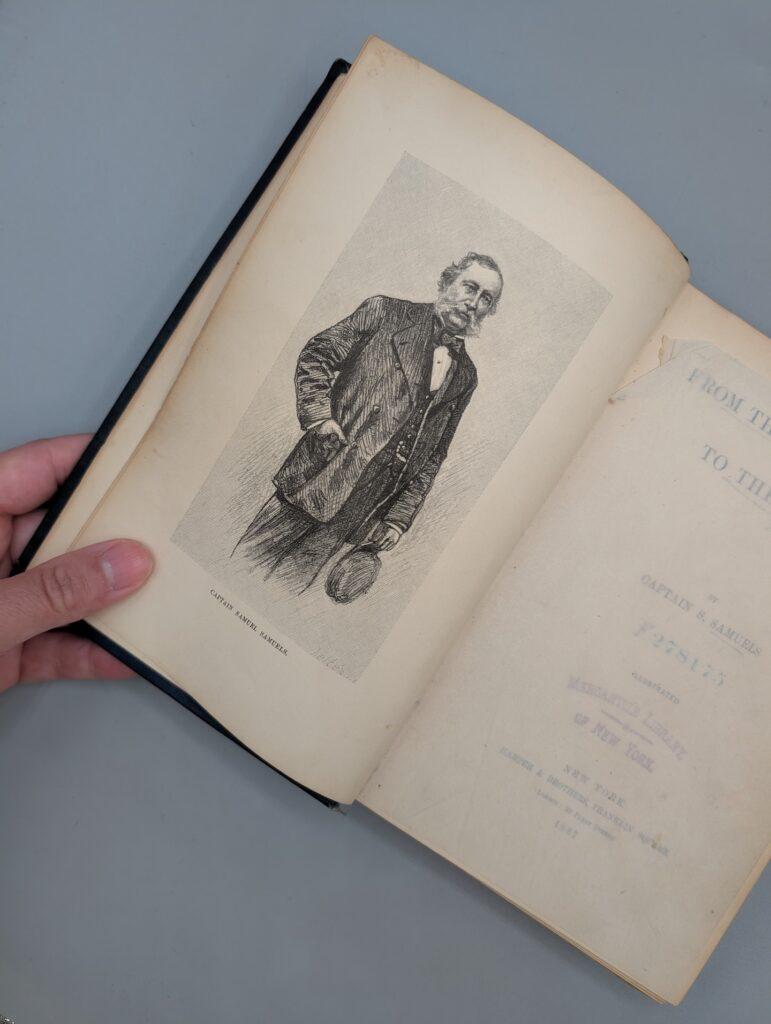
Right: “From the Forecastle to the Cabin”, by Capt. Samuel Samuels, Harper and Brothers, 1887. Rare Book Collection.
And finally, a bookish connection. The Museum’s Rare Book Collection includes Samuel Samuels’ autobiography, titled From the Forecastle to the Cabin. Published in 1887, the book is an important source on 19th century maritime life, though later scholarship cautions that it is not always strictly factual. Captain Samuels’ (real or imagined) adventures at sea include rescuing a Christian lady from a Harem in Constantinople, escaping “cannibals” in the South Pacific, and a mutiny at Manila that ends in blood.
World War I Witnesses
It is always special when a donor comes back with another donation, demonstrating their trust in the Museum’s mission. In 2025, Dudley Cunningham donated the Alice Vanderbilt Morris’ Tankard to the Museum. This is a unique piece of decorative art once owned by Alice (Shepard) Morris (1874–1950), a grand-daughter of William H. Vanderbilt (1821–1885).
This year, the same donor offered the Museum four letters that had been in his family for over a century. I got excited about the prospect of having more materials for our Archives Volunteers to transcribe, and even more so when I learned that these letters were from World War I. His grandfather, T. Dudley Cunningham, enlisted in the American Expeditionary Forces and served as a doctor on the frontlines, supporting British troops and French civilians before the United States joined the war. The letters, addressed to his parents back in Colorado, describe his journey to Europe aboard a Cunard steamer, the daily routine of a British field hospital, and the gruesome reality of war. One letter from April 2, 1917 (only four days before the United States entered World War I) contains a powerful quote about the wartime doctor’s perspective on the conflict:
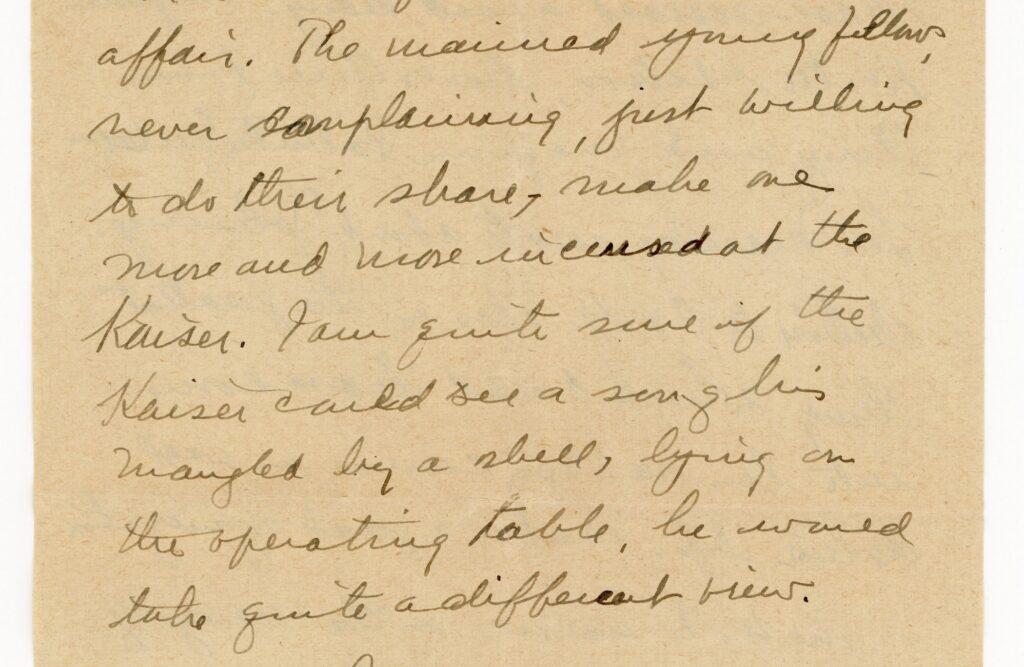
“The maimed young fellows, never complaining, just willing to do their share, make me more and more incensed at the Kaiser. I am quite sure if the Kaiser could see a son of his mangled by a shell, lying on the operating table, he would take quite a different view.”
[Letter from T. Donald Cunningham to his mother], April 2, 1917. 2026.007.0003.A-.D
These letters add another layer of meaning to our archival materials and objects related to the Great War in our collections, which include watercolor dazzle paintings, military medals, and posters, and the Harry Handly Caldwell Collection, relating to his career in the United States Navy. While many of these objects relate to military naval history and the public side of the war, the four letters donated by Dudley Cunningham provide a personal, intimate look on the everyday reality of conflict.
Ocean Liner Wonders
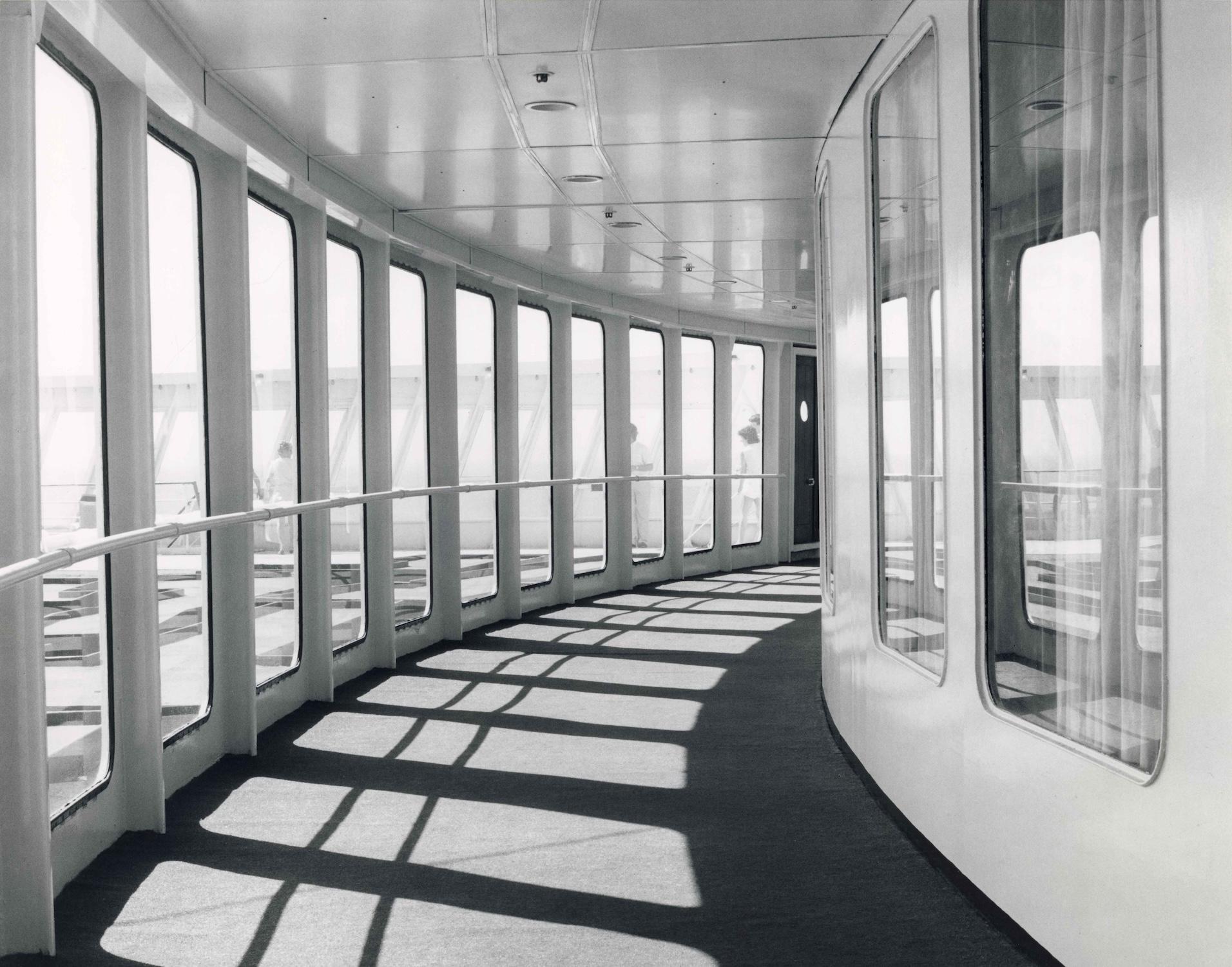
It is always an honor when a living artist reaches out and trusts us to preserve their work. In Spring 1998, fine art photographer Barry M. Winiker had a solo exhibition at the Museum, and decided to donate one of his favorite prints as a sign of appreciation. This year, Winiker came back with a generous donation of three black and white photographs he took aboard the iconic ocean liner Queen Elizabeth 2 and two cruise ships, Crown Princess and Oosterdam. Through his photography, he has immortalized ocean liners, cruise ships, and his travels for over four decades.
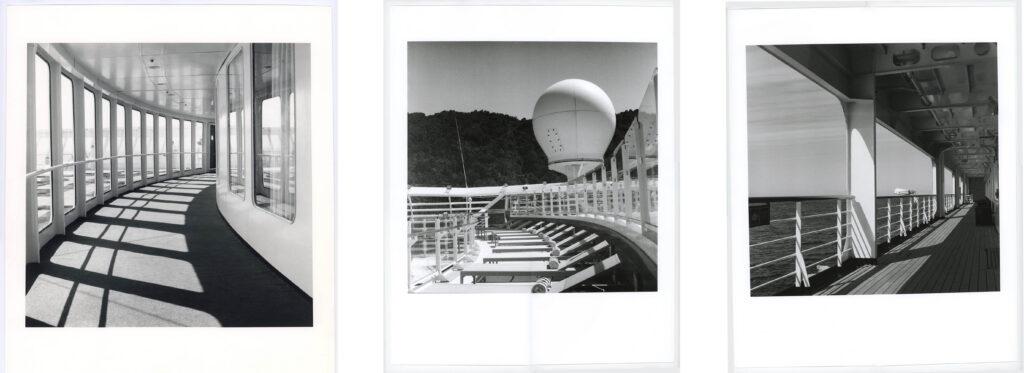
Photographs by Barry Winiker. Gift of the photographer, 2026.006. Left to right:
Cunard Line’s Queen Elizabeth 2, 1981.
Princess Cruises’ Crown Princess, 2024.
Holland America Line’s Oosterdam, 2024.
What the digital scans above can’t convey is the scale of the photographs: these are large, awe-inspiring prints. The ships, depicted in black and white, seem frozen in time, everything perfectly still. I also love how lights and shadows play together in these three photographs, creating a sense of rhythm with the repetition of the design features of each ship. Winiker’s photographs are a welcome new and different addition to our extensive collection of ocean liner memorabilia and archival materials. These images allow us to take a look at ocean liners from a different angle, straddling the line between fine art photography and documentary photography of the age of ocean liners and cruise ships.
Fun fact: Barry M. Winiker is Harriet Finck’s neighbor: she donated ten drawings of shipwright tools to the Museum last year, and you can admire one of them in our permanent exhibition Maritime City!
Building Trust and Enriching History
The fact that so many donors decide to trust the Museum again and again with their collections is a real source of pride for our institution. Donor retention is a concrete sign that the Collections Department, and Museum as a whole, is doing a great job taking in their donated items, cataloging them with care, and sharing them with the public in person in our exhibitions, and online, in our social media, blogs, and free Collections Online Portal.
The collections and archives of the South Street Seaport Museum document the rise of New York as a port city, and its role in the development of the economy and business of the United States through social and architectural landscapes through over 30,000 works of art and historical artifacts, and over 80,000 archival materials. Each new donation adds a new layer of meaning to the existing holdings: archival materials fill in gaps in knowledge, provide additional context to art and artifacts, or reveal hidden, individual stories in large-scale historical events. It is a true privilege to be on the receiving end of these incredible archival materials, and I am excited about what the rest of the year will bring.
Additional Readings and Resources
South Street Seaport Museum’s Acquisition Guidelines
South Street Seaport Museum’s Collections Management Policy
References
| ↑1 | Learn more about N. B. Palmer (and her ship model!) in the Collections Chronicles Blog “Deepening the Story”: https://southstreetseaportmuseum.org/deepening-the-story/ |
|---|---|
| ↑2 | ”The low house, Shanghai, ca. 1865–1870”, Artnet, https://www.artnet.com/artists/chowkwa/the-low-house-shanghai-o8p5DL-gkzyJAlch_bwtQ2 |