

Recent Additions to the Seaport Museum Collections
A Collections Chronicles Blog
By Martina Caruso, Director of Collections and Exhibitions
January 8, 2026
The Seaport Museum’s collections are far more expansive than many people realize. While we are the home of some of the finest 19th century scrimshaw, paintings, and ship models, as well as prized early 20th century photographs and ocean liners materials, our mission and vision of telling the history of New York from a maritime lens have created a foundation that allows us to expand our collections in innovative and inspiring ways.
While we do care for and preserve historical artifacts, we are also a dynamic space that connects the past with the present. We collect and display historical and contemporary art, technology, and interactive experiences that invite visitors to participate rather than just observe. So, contrary to the perception of museums collecting mostly “old and antiquated” pieces, our collections encompass a dynamic range of items evolving to engage people of all ages.
Today, guided by a collections management policy that acknowledges the global nature of our holdings, new acquisitions significantly expand the Museum’s ability to share a broad and inclusive array of historical narratives with visitors, students, and scholars. This blog post provides a glimpse into some of our recent acquisitions, sharing our ongoing commitment to expanding and diversifying our collections.
Foundational History
Over the past year, there have been a surprising number of new additions to our “foundational history.” These new acquisitions are fundamental to the roots of the Seaport neighborhood and the creation of the South Street Seaport Museum, including our buildings, ships, and collections.
First, are two additions related to Schermerhorn Row. Built as a real estate investment for captain, shipchandler, and merchant Peter Schermerhorn (1749–1826), Schermerhorn Row was designed with the bustling 19th century East River waterfront in mind. Each address in this block of buildings offered a storefront, an office, and ample warehouse space on upper floors for the goods flowing into the port city. The Row’s location proved excellent for business; nearby, the Fulton Ferry conveniently connected Manhattan to Brooklyn in 1814 and the Fulton Market opened across the street in 1822.
In late 2024, we were offered to purchase a land grant document issued to Peter Schermerhorn, sealed and signed by New York City Mayor Marinus Willett Esquire (1740–1830) on December 14, 1807. This unique document sheds light on how Peter Schermerhorn obtained the water lot grant that allowed him to fill in the area and create the land on which he would build Schermerhorn Row.

“Peter Schermerhorn Land Grant” 1807. Paper, ink, textile. Museum Purchase with funds by Anne E. Beaumont 2024.003
Marinus served as the City’s Mayor from 1807–1808—only a single year. His great-grandfather Thomas Willett (1610–1674), however, was New York City’s very first mayor, appointed to guide the city of New Amsterdam through its official transformation as a British property in 1665. According to author Frederick L. Bronner: “It is a possibility that Willett witnessed the first and last battle in New York during the Revolution.”[1]”Meet Mayor Marinus Willett, New York’s Warrior Mayor” by Bowery Boys, July 8, 2021.
Water lots were parcels of waterfront real estate sold by the city and required to be filled in by their new owners (at their own expense). This new land became some of the city’s most valuable and versatile real estate, and merchants could construct it to suit their needs. It also extended the shoreline out to deeper waters, so that ships could tie up to piers directly instead of anchoring offshore and having to unload their goods from there.[2]”Unearthing Gotham” by Anne-Marie Cantwell and Diane Wall, 2001, pp. 225–226.
The document was one a once-in-a-lifetime opportunity and we were really lucky to be able to acquire it thanks to the contribution of a generous long-time Museum supporter.
A few months later, we happened to continue this excitement thanks to the New York State (NYS) Office of Parks, Recreation and Historic Preservation when they reached out about “some long-term questions” that they had “concerning South Street Seaport’s collections in the State storage facility.” Between 1973 and 1979, NYS collected artifacts and architectural fragments tied to the Schermerhorn Row Block in anticipation of the creation of a New York State Maritime Museum. When the project did not materialize, NYS kept the artifacts and the documentation for these items.[3]During the 1960s boom in New York City for the development of office space, Atlas-McGrath, a noted developer of such projects in the City, began to purchase the buildings on the Schermerhorn Row … Continue reading

[Documenting Schermerhorn Row’s preservation assessment for the NYSMM] 1977. South Street Seaport Museum Archives
The pieces were formally deaccessioned by NYS in 2003, and were only now available for transfer to us! I visited the NYS storage facility in upstate New York to review the materials that were offered and assess their condition. In the Spring of 2025, we accepted a treasure trove of material culture and ephemera that was found and documented in Schermerhorn Row by NYS preservationists over five decades ago.

“Coffee and S…” Sign, mid-19th century. Wood, paint. Transfer from New York State Office of Parks, Recreation and Historic Preservation 2025.012
Over 80 objects were delivered to us in two shipments, and—due to their components and conditions—we are still making a comprehensive assessment and cataloging plan, but here below you can see a few highlights. From business signs, furniture pieces, wallpaper fragments, personal accessories, and cooking utensils, to shipping labels, receipt, business ledgers, Valentine’s cards, and newspaper clippings, all of these items allow us to continue researching and enhancing our interpretation plans for the building.


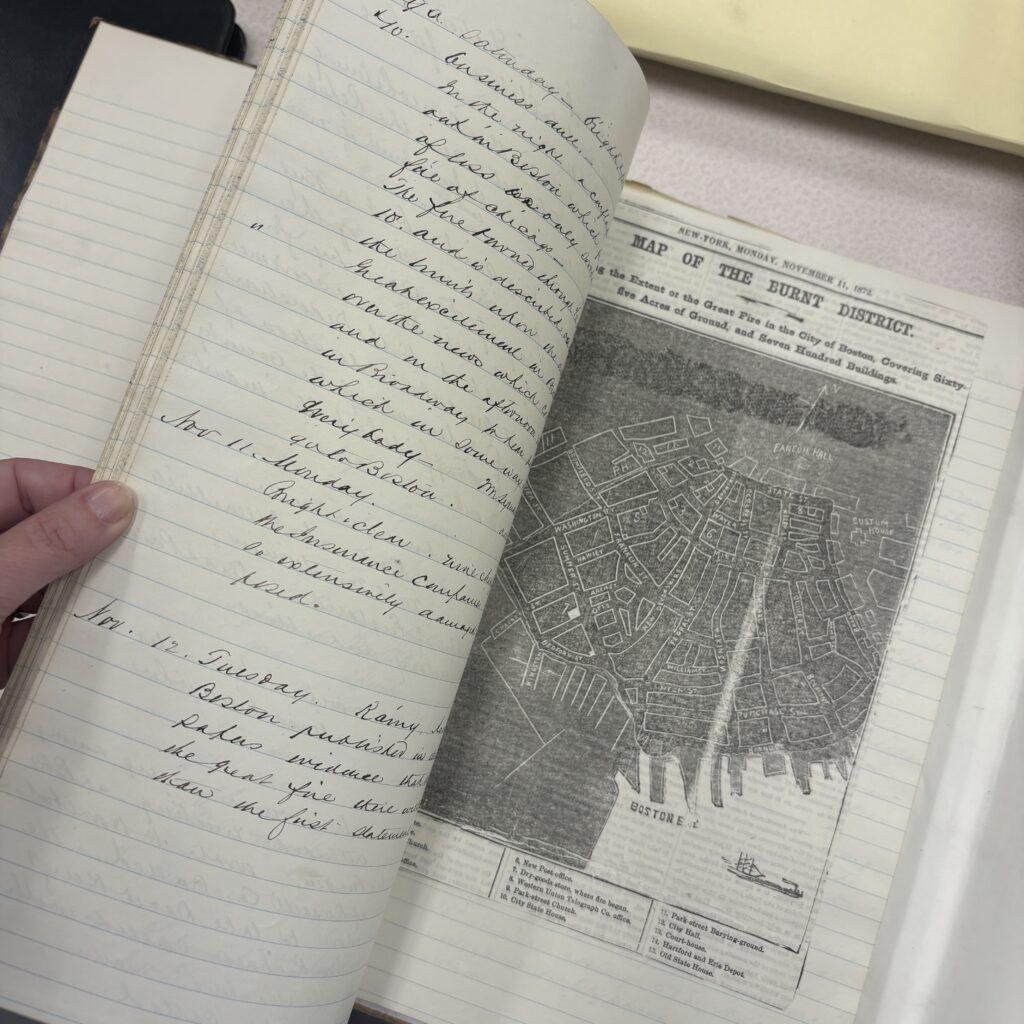


Transfer from New York State Office of Parks, Recreation and Historic Preservation 2025.012
Researching a Ship
N. B. Palmer was named after Arctic explorer, sailing captain, and ship designer Nathaniel Palmer (1799–1877), and on its first long voyage, it cut at least 30 days off the run to Shanghai. The ship was one of the many clipper ships of the A.A. Low & Brother, which was one of the most successful merchant firms in the 19th century trade between New York and China, with offices in the A.A. Low Building facing Burling Slip, today’s Seaport Museum administrative offices and archives.

Commanded by Captain Charles Porter Low (1824–1913)[4]”The Clipper Ship Era” by Arthur Hamilton Clark mentioned that: “At any early age he manifested a decided liking for ships and the society of sailors, and much against the wishes of his … Continue reading, N. B. Palmer was perhaps the most famous ship built in New York’s Westervelt shipyard.[5]”Jakob Westervelt was the son of a successful builder. He began his career in 1814 as an apprentice in Christian Bergh’s shipyard at the foot of Gouverneur Street, leaving in 1835 to … Continue reading
In China, she was known as “the Yacht,” due to her elegant design that included nettings in the tops, brass guns, gold stripe, and her lavish decorations on the Fourth of July and Washington’s Birthday. In 1892, the ship was abandoned in the North Atlantic at 45°N, 43°W.
“N. B. Palmer 1851” by Eric Erskine Campbell Tufnell (1888–1978). Watercolor. Gift of Melvin Conant 1974.049.0032
A model of the N. B. Palmer was displayed at The Great Exhibition of the Works of Industry of All Nations—more commonly known as the Crystal Palace Exhibition—in London in 1851, and supposedly attracted a great deal of attention and admiration.

An initiative spearheaded by Queen Victoria’s husband Prince Albert (1819–1861) and civil servant Henry Cole (1808–1882), the Great Exhibition was one of the most popular public attractions in 19th century London. It aimed to celebrate modern design and promote Britain as an industrial and imperial power—showing over 100,000 products from all four corners of the world.[6]”What was the Great Exhibition of 1851?” London Museum.
Illustration of the Great Exhibition at the Crystal Palace. Wikimedia Commons.
What makes the donation of this ship model even more special is the fact that it was donated by Clifford Orne Low and his family, and by accepting the donation the model has “gone home!”—as it was enthusiastically explained by the family. The model has been in the family for generations and it is plausible, due to its appearance and family stories, that this particular model dates back to the Crystal Palace exhibition, which would make it over 170 years old!

Ship model, Low family research papers, and the donors. Left to right: Theodore Seth Low (931433), Clifford Orne Low (93143), Elizabeth Davenport Low (931432), and Nathaniel Kelsey Low (931431).[7]The Low family traces back their history thanks to “Old Low, Old Low’s Son,” a fantastic book compiled by Abbot Low Moffat (1901–1996) gathering the descendants of Seth Low and Mary … Continue reading
The donor’s grandfather removed the model from the A.A. Low Building in the 1930’s after it was on view in the family business offices for many decades. The model was handed down to the donor’s father in the 1950’s and was handed down to Clifford Orne in the 1970’s.
N. B. Palmer is a great example of a ship model from the early-mid 19th century and provides a fascinating insight into ship design of the period. Clipper ships of the time had much less carving and gilding than those of the 18th and 17th centuries. However, the stern carvings include a large eagle and the name of the ship with its home port of New York.
We are currently engaging our object conservator to research the techniques and materials used to make this model, and I can’t wait to make a plan for its preservation and future addition on display.
Tattooing Legacy

Left: “Painted Cabinet Card Photograph of Tattoo Artists Gus and Maud Wagner” 1903. Museum Purchase 2025.005.0001
Center: “Lady Nora Hildebrandt” ca. 1890. Museum Purchase 2025.005.0002
Right: “Captain Jacob Hildebrandt” ca. 1890. Museum Purchase 2025.005.0003
Last year, we also acquired three cabinet cards to further develop our tattoo collection holdings, which are best known for the Alan Govenar and Kaleta Doolin Tattoo Collection.
One important avenue for advancing research and expanding this area of the collection is through the acquisition of materials that contextualize tattooing as both an artistic and cultural practice. Recent additions focus on the life and career of Augustus “Gus” Wagner (1872–1941) and his wife, Maud Stevens Wagner (1877–1961), who is widely regarded as the first professional female tattoo artist, as well as other tattoo artists active in New York during the same period.
This is where researchers, authors, collectors, and dealers play a vital role. Building relationships with these communities can support our long-term goal of establishing the institution as a leading repository for tattoo art and ephemera. The recently-acquired cabinet cards reflect this curatorial direction, strengthening the collection while contributing to its ongoing legacy.
The first cabinet card was taken in 1903, when the Wagners were performing with the Wonderland Shows in Terre Haute, Indiana. During this time, Gus briefly operated a tattoo shop and began tattooing Maud. The couple married the following year in St. Louis, Missouri, during the Louisiana Purchase Exposition, and subsequently promoted themselves as husband-and-wife tattoo artists.


Detail from “Painted Cabinet Card Photograph of Tattoo Artists Gus and Maud Wagner” 1903. Museum Purchase 2025.005.0001
The small, hand-painted tattoos applied over the original photograph reflect a technique Gus Wagner is known to have used on other images in his possession, including a few examples in the Museum’s Alan Govenar and Kaleta Doolin Tattoo Collection.
The other two cabinet cards were taken in 1890 by Charles Eisenmann (ca. 1850–1927). One features Lady Nora Hildebrandt (ca. 1857–1893), while the other depicts Brooklyn brewer Jacob Gunther, who became known as Captain Jacob Hildebrandt (active late 19th century); he was heavily tattooed and performed as a tattooed man in sideshow attractions alongside his partner, the tattooed lady Nora Hildebrandt.

Nora Hildebrandt is recognized as one of the earliest professional tattooed women, alongside Maud Wagner. In 1882, she debuted at Bunnell’s Dime Museum on Bowery Street in New York, where she displayed her 365 tattoos.
She went on to tour the country performing as a “tattooed lady,” while promoting a fabricated origin story—now understood as harmful and racist—about how she acquired her tattoos. This fictional narrative drew on the captivity-story genre, falsely claiming that she and her father had been abducted by a group of Indigenous people.[8]”A study of the Native American captivity narrative” by Megan Daniele Madden, 2014.
At the time, similar exploitative captivity narratives were widely circulated by white performers for financial gain. These stories reinforced racist stereotypes that have had lasting negative consequences, continuing to shape and harm perceptions and treatment of Indigenous peoples in the United States today.
In reality, Nora was tattooed by Martin Hildebrandt (ca. 1825–1890), one of New York’s earliest professional tattoo artists. He began his career as a sailor and continued tattooing during the Civil War. Although the two were not legally married, Nora assumed his surname and was often presented as either his daughter or wife. In fact, she was born in England and was neither married nor related to Martin. He is known to have tattooed several other women who worked as “tattooed ladies” in dime museums in New York and in traveling shows around the world.[9]”New York’s First Professional Tattooer” by Michelle Myles. January 11, 2016.
The history of tattooing at the turn of the 20th century is often marked by untold and, at times, controversial and difficult stories. These recent acquisitions provided an opportunity for thoughtful discussion within the Museum team, prompting us to engage more deeply with this complex history. Through rigorous research, sensitivity, and open dialogue, we were able to reexamine Nora Hildebrandt’s life and career through a contemporary lens.
A Silver Addition
This 1910 silver-plated tankard made by the British silversmiths at Elkington & Co. (1829–1963) is another notable recent acquisition.


Elkington & Co., manufacturer. “Alice Vanderbilt Morris’ Tankard” ca. 1910. Silver plated. Gift of Dudley Cunningham 2025.003
Once owned by Alice Vanderbilt Morris (1874–1950), this object allows us to fill in a gap in our collection of decorative art and the Gilded Age (ca. 1860–1900). During this period of time, interest in Greek and Roman culture increased as advances in steamship technology allowed more and more Americans, predominantly from the upper class, to travel to Europe and bring back artifacts from or items inspired by ancient cultures.
This tankard is an example of American high society’s fascination with Greek mythology, which you can see in the symbolism related to Dionysis (the Greek God of wine), festivity, vegetation, fertility, and theater.
Alice Vanderbilt Morris, also known as Mrs. Angela Alice Louise (Shepard) Morris, was the granddaughter of William H. Vanderbilt—the eldest son of Commodore Cornelius Vanderbilt, an heir to his fortune. Her mother, Margaret Louisa Vanderbilt (1845–1924), was the daughter of William Henry Vanderbilt and the sister of Cornelius Vanderbilt II. Her father, the ultra-conservative millionaire attorney and banker Elliot Fitch Shepard (1833–1893), founded the New York State Bar Association and owned and edited the newspaper Mail and Express.

As a child, Alice was known for her sweet disposition and angelic face—yet she occasionally displayed a spirit deemed unbecoming of a well-bred society girl, particularly one bearing the Vanderbilt name. During one such moment of defiance, Alice climbed a tree, a decidedly tomboyish act strictly forbidden by her stern father. She fell and fractured her thoracic spine. Reportedly, her father refused to summon a doctor as punishment for her disobedience. As a result, Alice would spend the rest of her life with scoliosis.
Her “delicate constitution” thereafter became a constant concern. She wore a brace for several hours each day and spent long periods reclining on a sofa.
As Alice entered her teenage years her beauty deepened. Having met her, Oscar Wilde is said to have remarked that there were only three destinations in the United States worthy of a traveler’s attention: Niagara Falls, the Grand Canyon, and Alice Shepard.
“Alice Vanderbilt Shepard” 1888, by John Singer Sargent (1856–1925). Amon Carter Museum of American Art, Fort Worth, Texas, 1999.20
The tankard and its owner’s history is actively being researched. In the meantime, the piece is now on view in the Museum’s galleries in the Maritime City exhibition located within the A.A. Thomson & Co. building.
Contemporary Tools
A collection of tools can often reveal a great deal about the person who used them. Are they rusty or carefully maintained? Old and worn, or shiny and new? Some tools may have been purchased, while others were passed down through generations of craftspeople, adding further layers to the stories they tell.

Left: “Jerome’s Saw” 2022. Ink on Stonehenge paper. Gift of Harriet Finck 2025.006.0001
Center: “Axe” 2022. Ink on Stonehenge paper. Gift of Harriet Finck 2025.006.0002
Right: “Mask” 2020. Ink on Stonehenge paper. Gift of Harriet Finck 2025.006.0005
These drawings are part of a series of ink on Stonehenge paper drawings by Harriet Finck, who created this group of works as a memorial to a neighbor who passed away from COVID-19 complications.
Finck is a painter based in Montclair, New Jersey. Trained as an architect, her work explores the interconnectedness of natural phenomena, revealing recurring patterns that span from the cellular to the astronomical, and examining how fragmentation can give rise to wholeness. Her subject matter has ranged from landscapes and still lifes to references to Constructivism, Hudson River School painting, and classical Hebrew texts. She typically works in color, using acrylic on paper or wood.
During the enforced isolation of the COVID-19 pandemic, however, she discovered the beauty and mystery of ordinary household tools. Tracing the objects directly onto paper, she left their forms empty and instead filled the surrounding void with black ink on white, animated by pulsating, minuscule shapes. She describes them as “ghostly presences, surrounded by a buzzing, loaded atmosphere.”

“Dancer (Pliers)” 2022. Ink on Stonehenge paper. Gift of Harriet Finck 2025.006.0009
Celebrating Ships
As the United States prepares to commemorate its 250th anniversary in 2026, plans are underway for a major celebration in the Port of New York and New Jersey. Sail4th 250, the nonprofit organization leading the effort, is organizing a six-day maritime celebration featuring an international flotilla of tall ships and naval vessels, with over 30 tall ships representing more than a dozen nations.
This tradition of large-scale ships’ parades began in the mid-20th century with Operation Sail—also known as OpSail. Founded as a nonprofit organization to foster global goodwill amid rising Cold War tensions, OpSail flourished in the latter half of the century, promoting international cooperation while celebrating maritime history and sail training initiatives worldwide.
As plans for Sail4th 250 progress, the Seaport Museum has been repeatedly asked to delve deeper into its archives, reflecting on its role as a member of the organizing committee from the very beginning. Longtime friends of the Museum have also reached out to offer materials to donate and preserve this history, recognizing the importance of documenting these significant New York City events. These recently-acquired slides are a compelling example of this ongoing legacy.

Operation Sail 1964 and 1976. 35mm slides. Gift of Richard Weir, 2025
The first OpSail took place in 1964, coinciding with the 1964 New York World’s Fair. In recognition of the visit of 23 sailing ships and their officers, cadets, and crew, New York City Mayor Robert Wagner (1910–1991) proclaimed “Operation Sail Week.”
An article titled Gathering of Great Ships by Anthony Anable, Jr., published in Boating magazine (January–June 1964), outlined the origins and ambitions of OpSail. Reflecting on the continued relevance of sail training, Anable wrote:
“In this modern age of nuclear power and Polaris missiles, it may seem odd that so many nations train their naval and merchant marine cadets under sail. However, such training has many advantages, not the least of which is learning a respect for the sea—which makes equal demands of a huge carrier or a brigantine. There is no better way to gain an intimate knowledge of these natural forces than to serve in sail.”
On July 14, 1964, a parade of some of the world’s last windjammers passed through New York Harbor. Thanks to British Pathé, a glimpse of this historic moment can still be seen today.
Windjammers Arrive At New York, 1964. British Pathé.
Operation Sail was conceived as both a demonstration of training under sail and a reaffirmation that great sailing ships continued to traverse the world’s oceans. The gathering of 1964 proved not to be a singular moment. In the decades that followed, OpSail vessels returned to New York Harbor to mark major national milestones, including the United States Bicentennial in 1976 and the Statue of Liberty Bicentennial in 1986.


Operation Sail 1976. 35mm slides. South Street Seaport Museum Archives.
For the nationwide Bicentennial celebrations in 1976, Operation Sail organized an unprecedented parade of 225 sailing ships from 30 nations, culminating in the main procession on July 4, 1976.
Although Operation Sail was not intended as a reflection on American history, it nonetheless brought New Yorkers together on a remarkable scale. As an international event, it reached far beyond the harbor itself, made widely accessible through television broadcasts and broad public participation along the waterfront.
I can’t wait to see what July 2026 has in store for the Museum, South Street Seaport, and all New Yorkers!
References
| ↑1 | ”Meet Mayor Marinus Willett, New York’s Warrior Mayor” by Bowery Boys, July 8, 2021. |
|---|---|
| ↑2 | ”Unearthing Gotham” by Anne-Marie Cantwell and Diane Wall, 2001, pp. 225–226. |
| ↑3 | During the 1960s boom in New York City for the development of office space, Atlas-McGrath, a noted developer of such projects in the City, began to purchase the buildings on the Schermerhorn Row Block from individual owners of these properties. The developer’s intention was to demolish the block. In 1966, in the wake of a feasibility study underwritten by the New York State Council on the Arts, the State legislature took action to authorize a group known as the South Street Maritime Museum association (SSMMA) to acquire and develop the State Maritime Museum.
In 1971, the Schermerhorn Row Block was listed on the National Register of Historic Places, and the Block was designated a landmark by the newly created Landmark Preservation Commission for the City of New York a few years later. From 1974 to 1976, the NYS Office of Parks and Recreation undertook preliminary historical and architectural research and study of museum planning options. In 1977, they commissioned the firm of Pokorny & Pertz Associates to perform site investigations and prepare contracts and plans for the stabilization of roofs, facades, and foundations. Between 1978 and 1979, as NYS was accelerating efforts to begin site construction for the State Maritime Museum. The South Street Seaport Museum engaged the development firm of Rouse, Inc. to do a feasibility study on the commercial revitalization of the Seaport area. After a series of discussions between the Seaport Museum, the Rouse Company, the UDC and NYS no merger agreement between the two plans of museum was reached, and the State determined that the economic and cultural interests of Lower Manhattan would be better served by a single museum. NYS began the steps to withdraw State plans in 1979. |
| ↑4 | ”The Clipper Ship Era” by Arthur Hamilton Clark mentioned that: “At any early age he manifested a decided liking for ships and the society of sailors, and much against the wishes of his parents, he determined to go to sea. In 1842 he shipped as a boy before the mast on board the Horatio, with Captain Howland and made the round voyage to China. He made a voyage to Liverpool with Captain Griswold as an ordinary seaman, and was an able seaman on board the Courier to Rio Janeiro. He then sailed as third, second, and chief mate of the Houqua, with the brothers Captain Nat, Alexander, and Theodore Palmer, and at the age of 23 took command of that ship. He also commanded Samuel Russell on her first voyage to San Francisco.” |
| ↑5 | ”Jakob Westervelt was the son of a successful builder. He began his career in 1814 as an apprentice in Christian Bergh’s shipyard at the foot of Gouverneur Street, leaving in 1835 to start his own operation. The original yard was at Corlear’s Hook, on the East River, but he moved to Lewis and 7th Streets in 1844, where the soccer field and running track in East River Park are today. Over the course of its 30-year existence, Westervelt built 243 ships, the early ones being sailing ships, the later being steamships, but he never converted to iron shipbuilding. In the later years, Westervelt owned many of the ships he built, with the result that the Civil War losses and the post-war collapse essentially bankrupted him and the yard closed in 1868.” shipbuildinghistory.com |
| ↑6 | ”What was the Great Exhibition of 1851?” London Museum. |
| ↑7 | The Low family traces back their history thanks to “Old Low, Old Low’s Son,” a fantastic book compiled by Abbot Low Moffat (1901–1996) gathering the descendants of Seth Low and Mary Porter from 1807–1956. Each member of the family is assigned a number to identify the order of birth, relations, and generations. |
| ↑8 | ”A study of the Native American captivity narrative” by Megan Daniele Madden, 2014. |
| ↑9 | ”New York’s First Professional Tattooer” by Michelle Myles. January 11, 2016. |